How to Calculate Asphalt Tonnage (Square Feet, Square Yards, and Formula)
If you’ve ever tried ordering asphalt, you’ve probably run into the same problem: you measured your project in square feet, but the asphalt plant (or contractor) talks in tons. That’s when the stress starts:
- “What if I over-order and waste money?”
- “What if I under-order and the crew can’t finish?”
- “Does 2 inches vs 3 inches really change the tons that much?”
- “Why do different calculators give different results?”
This guide makes it simple. You’ll learn how to calculate asphalt tonnage using the standard US method, plus quick ways to estimate using square yards and a short metric/tonnes section. You’ll also learn how to factor in compaction and waste, so you don’t end up short.
Try our Asphalt Calculator to convert square feet, thickness, and asphalt density into total asphalt tons in seconds.
What “Asphalt Tonnage” Means (and Why Asphalt Is Sold by Tons)
Asphalt tonnage is the weight of asphalt you need—usually Hot Mix Asphalt (HMA), also called an asphalt mix.
Plants sell asphalt by weight because it’s consistent for:
- batching and production,
- trucking,
- and invoicing.
But asphalt is installed by area and thickness, which means you must convert:
Area × Thickness → Volume → Weight → Tons
To do that correctly, you need one key piece: asphalt density (unit weight).
What You Need Before You Calculate (Quick Checklist)
1) Area (sq ft or sq yd)
Measure your area in:
- square feet (sq ft) (most common for homeowners), or
- square yards (sq yd) (common in paving quotes).
If the shape is irregular, break it into rectangles/triangles and add them up.
2) Thickness (inches)
Most asphalt thicknesses are in inches (2″, 3″, 4″).
Formulas need thickness in feet, so convert:
Thickness (ft) = Thickness (in) ÷ 12
3) Asphalt Density / Unit Weight
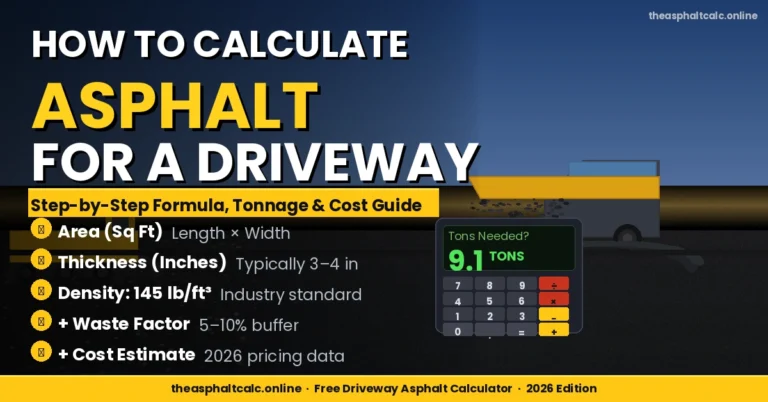
Many calculators use ~145 lb/ft³ as a practical industry-average for compacted Hot Mix Asphalt (HMA).
Important note: Asphalt density varies by mix design, aggregate type, and compaction. Typical compacted values are often in the 144–160 lb/ft³ range. If accuracy matters, confirm your mix density with your local asphalt plant.
The Standard US Formula (Imperial): Most Accurate Method
If you’re asking, “how do you calculate asphalt tonnage?” this is the method you want.
✅ Must-Include Formula (US / Imperial)
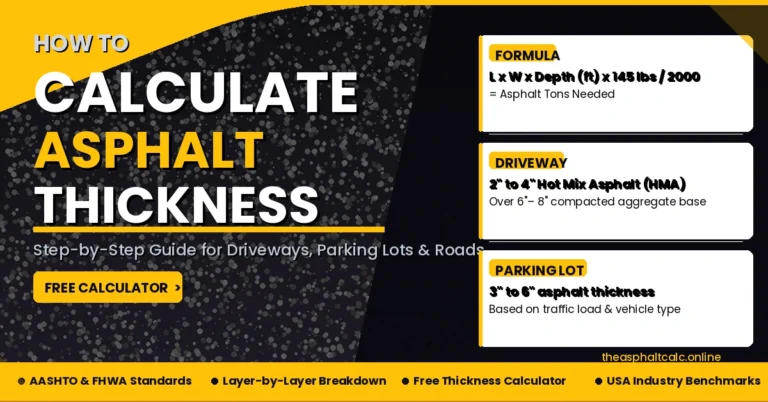
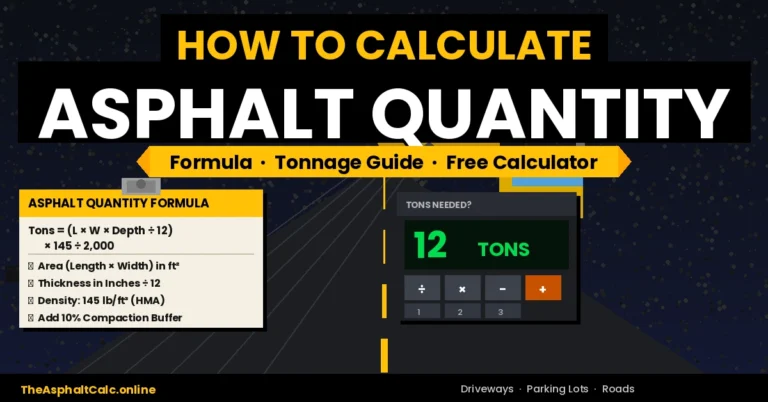
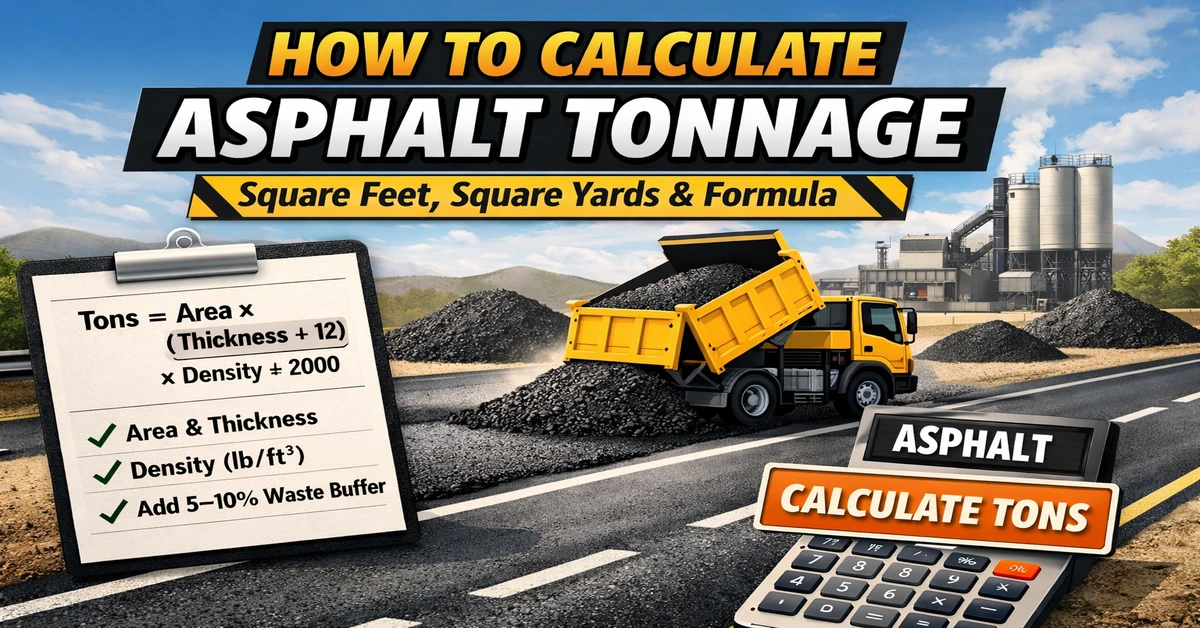
Tons = [Area (ft²) × (Thickness in ÷ 12) × Density (lb/ft³)] ÷ 2000
This calculates US short tons (1 ton = 2,000 lb).
Step-by-step breakdown
- Convert thickness: inches → feet
- Calculate volume: cubic feet (ft³)
- Convert volume to pounds: lbs
- Convert pounds to tons: lbs ÷ 2000
How to Calculate Asphalt Tonnage From Square Feet (Most Common)
If your project is measured in square feet, use the main formula as-is.
Example: Driveway at 3 inches thick
Let’s say your driveway is 40 ft × 20 ft with 3 inches compacted thickness.
- Area = 40 × 20 = 800 sq ft
- Thickness = 3 ÷ 12 = 0.25 ft
- Volume = 800 × 0.25 = 200 ft³
- Use density ≈ 145 lb/ft³
- Pounds = 200 × 145 = 29,000 lb
- Tons = 29,000 ÷ 2000 = 14.5 tons
That’s how to calculate asphalt in tons using square feet.
If you’re paving a home entrance, use our Driveway Asphalt Calculator to estimate driveway tons, thickness, and a 5–10% waste/compaction buffer.
Add a Compaction/Waste Factor (Don’t Skip This)
Real jobs aren’t perfect. Low spots, uneven bases, handwork around edges, and normal losses can push your required tonnage up.
A practical recommendation is a compaction factor / waste factor of 5–10%:
- +5% for simple shapes and clean installs
- +10% for irregular edges, tie-ins, patch work, or uncertain base conditions
So for 14.5 tons:
- 5% extra → 14.5 × 1.05 = 15.2 tons
- 10% extra → 14.5 × 1.10 = 16.0 tons
If you want to avoid running short, this buffer is the difference.
How to Calculate Asphalt Tonnage Per Square Foot (Fast Sanity Check)
Sometimes you want a quick check so your result “feels right.”
Using density 145 lb/ft³:
- At 2 inches (0.1667 ft):
lb/ft² = 0.1667 × 145 ≈ 24.2 lb/ft²
tons/ft² = 24.2 ÷ 2000 ≈ 0.0121 tons/ft² - At 3 inches (0.25 ft):
lb/ft² = 0.25 × 145 = 36.25 lb/ft²
tons/ft² = 36.25 ÷ 2000 ≈ 0.0181 tons/ft²
This is helpful for catching mistakes quickly—especially thickness conversion errors.
How to Calculate Asphalt Tonnage From Square Yards
If you’re working from square yards, you have two clean options.
Conversion: sq ft ↔ sq yd
- 1 sq yd = 9 sq ft
- sq yd = sq ft ÷ 9
- sq ft = sq yd × 9
Method A (simple and accurate)
- Convert square yards to square feet (× 9)
- Use the main formula:
Tons = [Area (ft²) × (Thickness in ÷ 12) × Density (lb/ft³)] ÷ 2000
This is the safest method because all units stay consistent.
Working on a commercial project? Use our Parking Lot Asphalt Calculator to estimate asphalt paving tonnage for larger areas (square yards, thickness, and density).
Volume Method: Cubic Feet → Cubic Yards (Contractor-friendly)
Some contractors estimate using cubic yards because it’s easy for hauling.
Key conversions
- Volume (ft³) = Area (ft²) × Thickness (ft)
- Cubic yards (yd³) = ft³ ÷ 27
If density ≈ 145 lb/ft³, one cubic yard of asphalt weighs roughly:
- 1 yd³ = 27 ft³
- Weight ≈ 27 × 145 = 3,915 lb
- Tons ≈ 3,915 ÷ 2,000 = 1.96 tons
So, how many tons are in 1 cubic yard of asphalt?
A common practical estimate is about 2 tons per cubic yard, assuming 145 lb/ft³.
Square Yards Shortcut (Rule-of-Thumb): Use Carefully
There’s a common estimating shortcut that uses pounds per square yard per inch thickness. Many paving crews use a typical range like:
108–120 lb per square yard per inch (varies by mix and compaction)
Shortcut formula (square yards)
Tons = [Area (sq yd) × Thickness (in) × (108 to 120)] ÷ 2000
This is useful for rough budgeting or quick checks, but it’s still an estimate. For ordering, the main formula is more dependable—especially on larger jobs.
Quick Reference: Conversions You’ll Use All the Time
- inches → feet: ÷ 12
- lbs → tons: ÷ 2000
- sq ft ↔ sq yd: 1 sq yd = 9 sq ft
- ft³ ↔ yd³: 1 yd³ = 27 ft³
Coverage Guide: How Many Square Feet Does 1 Ton of Asphalt Cover?
People ask this all the time, and it’s a great reality check.
Using density 145 lb/ft³:
- 1 ton = 2,000 lb
- Volume ≈ 2,000 ÷ 145 ≈ 13.8 ft³
Coverage depends on thickness:
- 2 inches (0.1667 ft): 13.8 ÷ 0.1667 ≈ 83 sq ft per ton
- 3 inches (0.25 ft): 13.8 ÷ 0.25 ≈ 55 sq ft per ton
- 4 inches (0.333 ft): 13.8 ÷ 0.333 ≈ 41 sq ft per ton
These are approximate, but they help confirm you’re in the right range.
Metric Section: Tonnes of Hotmix Asphalt (In Metric)
If you’re working in metric measurements, use these:
✅ Must-Include Metric Formulas
- Volume (m³) = Area (m²) × Thickness (m)
- Tonnes = Volume (m³) × Density (kg/m³) ÷ 1000
Density in kg/m³ varies by mix. A common equivalent estimate to 145 lb/ft³ is around 2,320 kg/m³, but you should confirm with your local supplier for best accuracy.
Common Mistakes That Cause Wrong Tonnage (And How to Avoid Them)
- Forgetting inches → feet conversion
- 3 inches = 0.25 ft, not 0.3 ft
- Using the wrong density
- HMA density changes with mix design
- Skipping the 5–10% buffer
- real jobs rarely match perfect math
- Under-measuring area
- flares, tapers, and aprons add hidden square footage
- Mixing units
- sq yd with ft³ without converting creates bad estimates fast
FAQs
How many tons of asphalt do I need for a driveway?
Measure your driveway area in square feet, choose a compacted thickness (often 2–3 inches depending on base and traffic), use the main formula, and then add 5–10% for compaction/waste.
How many tons of asphalt per square yard at 2 inches?
Using the shortcut range:
108–120 lb/sy/in × 2 inches = 216–240 lb per sq yd
Tons per sq yd = 216–240 ÷ 2000 = 0.108–0.120 tons per sq yd
This is a rule-of-thumb. The main formula is more accurate.
How many square feet does 1 ton of asphalt cover (by thickness)?
Approximate coverage using 145 lb/ft³:
2 inches: ~83 sq ft
3 inches: ~55 sq ft
4 inches: ~41 sq ft
How many tons are in 1 cubic yard of asphalt?
A typical estimate is about 2 tons per cubic yard for hot mix asphalt when using a 145 lb/ft³ density assumption.
Should I add extra asphalt for waste/compaction (5–10%)?
Yes. Adding 5–10% helps prevent under-ordering and accounts for real-world conditions like low spots, edge work, and normal material loss.
Final Takeaway: The Reliable Way to Calculate Asphalt Paving Tonnage
Use this every time for a solid result:
Tons = [Area (ft²) × (Thickness in ÷ 12) × Density (lb/ft³)] ÷ 2000
- Use 145 lb/ft³ as a reasonable starting estimate for Hot Mix Asphalt (HMA) when you don’t have exact mix data.
- Confirm density with your asphalt supplier if precision matters.
- Add 5–10% extra for compaction and waste so you don’t come up short.
Want to skip the math? Use our Asphalt Calculator to estimate asphalt tons with waste/compaction included.