How Much Asphalt Do I Need? Coverage Per Ton, Calculator & Formula
Whether you’re paving a driveway, patching a trench, or resurfacing a parking lot, the first question is always the same: how much asphalt do I need? Order too little and your crew stops mid-job, paying emergency delivery premiums. Order too much and you’ve wasted hundreds of dollars on material sitting in a pile.
This guide gives you the exact formula, a full coverage-per-ton table at every thickness, and step-by-step worked examples — the same method used by our free asphalt calculator — so you can walk into any supplier conversation with a confident number.
How Much Does 1 Ton of Asphalt Cover?
This is the single most searched question in asphalt estimating — and it’s also the simplest to answer once you know the thickness.
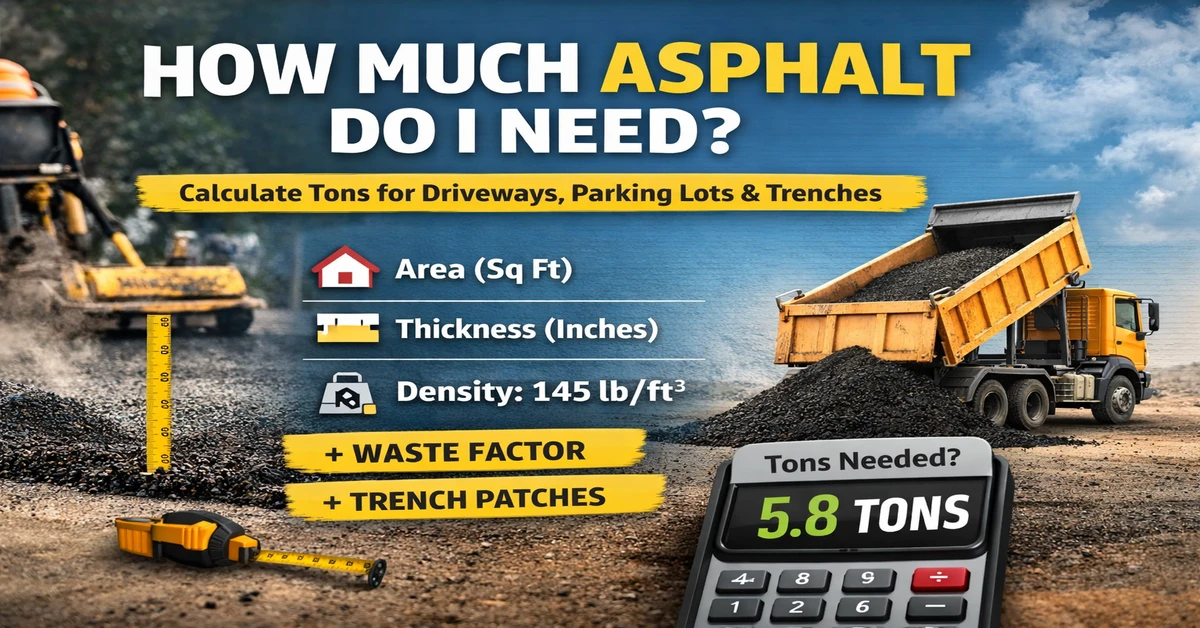
1 ton of asphalt coverage at standard density (145 lb/ft³):
| Compacted Thickness | Sq Ft per Ton | Sq Yards per Ton | Common Use |
|---|---|---|---|
| 1.5 inches | ~110 sq ft | ~12 sq yd | Light resurfacing over solid base |
| 2 inches | ~80 sq ft | ~9 sq yd | Residential driveway overlay |
| 2.5 inches | ~64 sq ft | ~7 sq yd | Heavier residential / light commercial |
| 3 inches | ~55 sq ft | ~6 sq yd | Driveways with trucks, SUVs |
| 4 inches | ~41 sq ft | ~4.5 sq yd | Parking lots, commercial areas |
| 6 inches | ~27 sq ft | ~3 sq yd | Heavy traffic roads, truck aprons |
How to use this table: Find your compacted thickness, then divide your total square footage by the “Sq Ft per Ton” number. That gives you the base tons needed before waste factor.
Example: 640 sq ft driveway at 2.5 inches → 640 ÷ 64 = 10 tons (before waste)
These figures are based on hot mix asphalt (HMA) at 145 lb/ft³ — the industry standard density cited by the National Asphalt Pavement Association (NAPA). For cold patch asphalt (~105 lb/ft³) or recycled asphalt (RAP, ~135 lb/ft³), coverage per ton will differ. Always confirm density with your supplier for critical projects.
The Asphalt Tonnage Formula
If you want to calculate asphalt tons manually — whether for a driveway, parking lot, or road — here is the standard formula used by every professional estimator and asphalt calculator tool:
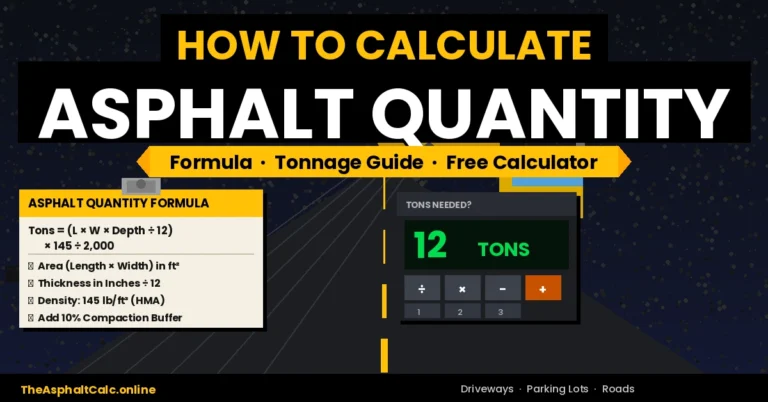
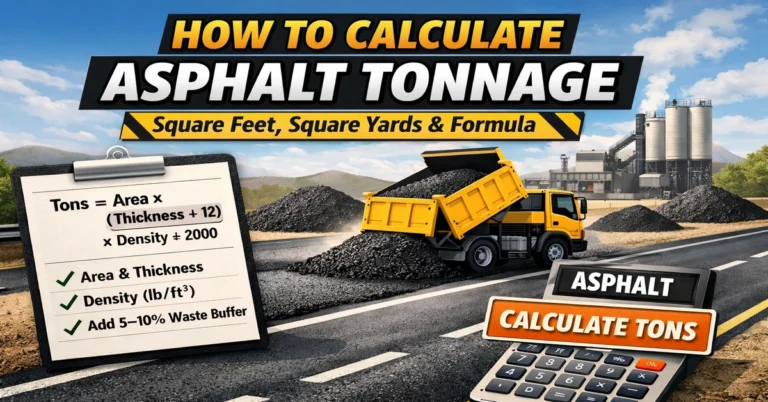
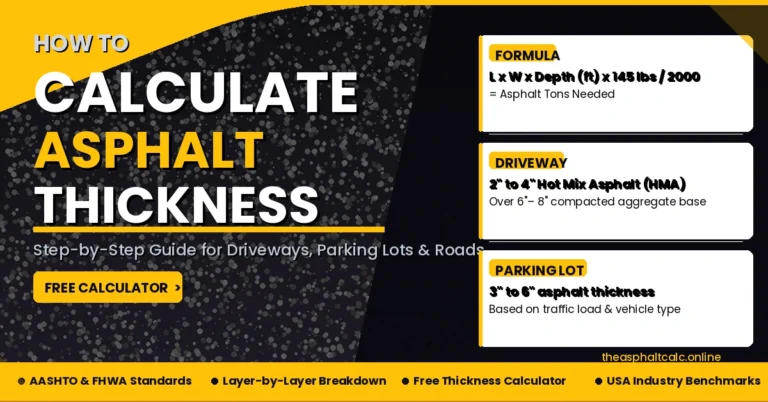
Asphalt Tons = (Area in sq ft × Thickness in inches ÷ 12 × Density in lb/ft³) ÷ 2000
Default density for quick estimates: 145 lb/ft³ Typical in-place range: 142–148 lb/ft³ depending on mix, aggregate, and compaction.
Step-by-Step: How to Calculate How Much Asphalt You Need
This is the same logic behind every reliable asphalt estimator tool. If you’ve searched “how to calculate asphalt tonnage” or “how to figure asphalt tonnage,” here’s the clean method.
Step 1 — Measure the area (sq ft)
Measure the surface you need to pave.
- Rectangle: Length × Width
- Irregular shapes: Split into rectangles, calculate each section separately, then add them together.
Example (standard residential driveway): 40 ft × 12 ft = 480 sq ft
Use our Asphalt Driveway Calculator if you need to handle multiple sections automatically.
Step 2 — Convert thickness (inches to feet)
Thickness is usually specified in inches but the formula requires feet.
Thickness (ft) = Thickness (in) ÷ 12
Example: 2 inches ÷ 12 = 0.167 ft
Step 3 — Calculate volume (cubic feet)
Volume (ft³) = Area (sq ft) × Thickness (ft)
Example: 480 × 0.167 = 80.16 ft³
Step 4 — Convert volume to tons
Tons = Volume (ft³) × Density (lb/ft³) ÷ 2000
Example (using 145 lb/ft³): 80.16 × 145 = 11,623 lb 11,623 ÷ 2,000 = 5.81 tons
✅ Result: A 480 sq ft driveway at 2 inches compacted thickness requires approximately 5.8 tons before waste factor.
Want to skip the math? Plug your measurements into our free asphalt calculator to get instant results in tons, cubic yards, and weight.
Asphalt Coverage in Square Yards
Many contractors and suppliers still quote asphalt in square yards rather than square feet. To convert your area from square feet to square yards, divide by 9 (since 1 sq yd = 9 sq ft).
Tons of asphalt from square yards:
Tons = (Area in sq yd × 9 × Thickness in inches ÷ 12 × 145) ÷ 2000
Quick reference — tons per 100 sq yd at common thicknesses:
| Thickness | Tons per 100 sq yd |
|---|---|
| 2 inches | ~11.1 tons |
| 3 inches | ~16.6 tons |
| 4 inches | ~22.2 tons |
To convert the other way — asphalt square yards to tons — simply multiply your square yardage by the tons-per-sq-yd factor for your thickness.
For full metric conversions (square metres / tonnes), see the metric section at the bottom of this guide or use the metric mode on our main calculator.
How to Measure Asphalt for Your Project
Knowing how to measure for asphalt correctly is what separates a clean estimate from a costly mistake. Here are the rules pros follow:
For driveways: Measure the full length and width at the widest points. If the driveway flares at the apron (street end), split that section into a separate rectangle and add it to the main run.
For parking lots: Divide the lot into rectangular zones. Calculate each zone separately — especially if different areas will have different thickness requirements (drive lanes, stall areas, truck aprons). Our Parking Lot Asphalt Calculator handles multi-zone layouts automatically.
For trench patches: Measure the saw-cut width, not the trench width. The patch is always wider than the trench itself. See the full trench section below.
Key measurement rule: Asphalt is measured in compacted thickness — the final in-place depth after rolling, not the loose mat depth off the truck. Always specify compacted thickness when ordering and estimating.
How Thick Should My Asphalt Driveway Be?
Thickness selection is where most homeowners either over-spend or under-build. Here’s the practical guide:
| Compacted Thickness | Recommended Use | Notes |
|---|---|---|
| 1.5 inches | Light resurfacing only | Requires a fully intact, structurally sound existing base |
| 2 inches | Standard residential driveway overlay | Minimum for durability on new installations |
| 2.5–3 inches | Heavier residential use, trucks, trailers | Better longevity for vehicles over 5,000 lbs |
| 3–4 inches | Parking lots, commercial driveways | Common standard for light commercial |
| 4–6 inches | Roads, heavy vehicle areas | Often installed in two lifts for proper compaction |
For a deep dive on thickness selection by soil type, traffic load, and climate, see our full guide: How to Calculate Asphalt Thickness.
Why multiple lifts matter: Any layer thicker than 3 inches is typically placed in two compacted lifts rather than one thick layer. A single 4-inch lift doesn’t compact uniformly — two 2-inch lifts will produce a denser, longer-lasting surface. This also affects your tonnage ordering: plan your waste factor higher on multi-lift jobs.
Compaction and In-Place Density: Why Your Tonnage Changes
One reason you’ll see different tonnage answers to “how many tons of asphalt do I need” is compaction. Asphalt leaves the plant at a loose density and compacts down significantly under the roller.
Most quantity estimates — including every number in this guide — are based on compacted thickness. If you’re ordering for a 2-inch compacted depth, the loose mat placed by the paver will actually be closer to 2.4–2.6 inches before rolling. This is normal and already accounted for in the 145 lb/ft³ density figure.
Where compaction creates problems:
- Large parking lots and road projects where base conditions vary across the site
- Trench patches where you’re matching existing pavement elevation within a saw-cut frame
- Multi-lift installations where each lift’s compaction affects the next
On those jobs, always get a density figure from your specific supplier’s mix design rather than relying solely on the 145 lb/ft³ default.
How Much Asphalt Do You Need After a Trench?
Utility cuts and trench patches are the #1 area where contractors come up short on material. The reason is almost always the same: they measured the trench width instead of the saw-cut patch width.
What you should measure:
- Saw-cut patch width — the patched area is always wider than the trench itself
- Patch length — along the entire run of the cut
- Compacted lift thickness — often 3–4 inches total, potentially in two lifts
- Number of lifts — required for deeper patches
Trench patch area: Patch Length × Saw-Cut Patch Width = Area (sq ft)
Trench Patch Worked Example
Scenario: Utility cut restoration
- Patch length: 30 ft
- Saw-cut patch width: 3 ft
- Final compacted thickness: 4 inches
- Density: 145 lb/ft³
- Waste factor: 10% (trench patches have more edges and transitions)
Step A — Area: 30 × 3 = 90 sq ft
Step B — Thickness in feet: 4 ÷ 12 = 0.333 ft
Step C — Volume: 90 × 0.333 = 29.97 ft³
Step D — Weight to tons: 29.97 × 145 = 4,345 lb 4,345 ÷ 2,000 = 2.17 tons
Step E — Add waste: 2.17 × 1.10 = 2.39 tons
✅ For this trench patch, order approximately 2.4 tons.
Why “one thick layer” causes trouble: A 4-inch patch performs significantly better when installed as two 2-inch compacted lifts. Single thick lifts don’t compact uniformly, are prone to cracking, and are harder to bring to the correct elevation within the saw-cut frame.
For more detail on calculating tonnage from square footage for patch work, see our guide on how to calculate asphalt tonnage.
Waste Factor: Don’t Skip This
Waste is the gap between your calculated tonnage and what you actually need to order. Edges, grade changes, hand raking, and minor thickness variation all consume extra material.
| Project Type | Waste Factor to Apply |
|---|---|
| Large, uniform paving (parking lot, long straight driveway) | 5% |
| Standard residential driveway | 7% |
| Small patch repairs, lots of edges | 8–10% |
| Trench restoration, uneven grades, multiple lifts | 10%+ |
Recommended order quantity = Calculated tons × 1.05 to 1.10
Example: 5.81 tons × 1.07 = 6.22 tons → round up to supplier minimum.
How Asphalt Is Measured and Sold
Understanding how asphalt is measured helps you communicate with suppliers and verify quotes.
Hot mix asphalt (HMA) — also called blacktop, tarmac, or bitumen depending on your region — is sold and measured by weight in US tons (short tons, 2,000 lb each) in North America. In the UK and most of Europe, it’s sold by metric tonnes (1,000 kg ≈ 1.102 US tons).
Key conversions:
- 1 US short ton = 2,000 lb
- 1 metric tonne = 2,204 lb ≈ 1.10 US tons
- 1 cubic yard of compacted HMA ≈ 2.0 US tons (at 145 lb/ft³)
- 27 cubic feet = 1 cubic yard
If you need to convert square yards to tons of asphalt: Use the formula: (Sq Yd × 9 × Thickness in inches ÷ 12 × 145) ÷ 2000
How much tarmac do I need? (UK readers) — “Tarmac” is the common UK term for asphalt/bitumen surface dressing. The calculation method is identical. Use the same formula with metric tonnes instead of short tons: multiply your result in short tons by 0.907 to get metric tonnes. At 50mm (2 inches) thickness, 1 metric tonne covers approximately 7–8 square metres.
How Much Does Asphalt Cost?
A brief cost reference helps you cross-check your material estimate against contractor quotes.
- Hot mix asphalt (HMA): $85–$150 per ton for material only, depending on location, oil prices, and mix type
- Asphalt driveway installation (material + labor): $4,000–$8,000 for a standard residential driveway
- Installed cost per sq ft: roughly $3–$7 depending on project size, thickness, and region
These are planning figures only. Always get quotes from local suppliers — your price per ton will determine how much your waste factor actually costs you, which is why ordering accurately matters.
Common Mistakes That Make Your Estimate Wrong
These errors show up constantly in driveway, patch repair, and utility cut projects:
- Forgetting to divide inches by 12 — the single biggest math error in asphalt estimating
- Measuring trench width instead of saw-cut patch width — you almost always patch wider than you dig
- Skipping the waste factor — edges and transitions eat material on every job
- Mixing units without converting — sq yd vs sq ft, yd³ vs ft³, US tons vs metric tonnes
- Assuming one thick lift compacts correctly — anything over 3 inches needs two lifts
- Using a random density — always use 145 lb/ft³ as your default, or get the actual figure from your mix supplier
- Not accounting for base preparation — if the base is uneven, you’ll use more material to reach consistent depth
FAQs
How to calculate how much asphalt I need?
Measure your area in sq ft, choose your compacted thickness in inches, then apply: Tons = (Area × Thickness ÷ 12 × 145) ÷ 2000. Add 5–10% waste. Or use the free calculator.
How many tons of asphalt do I need for a driveway?
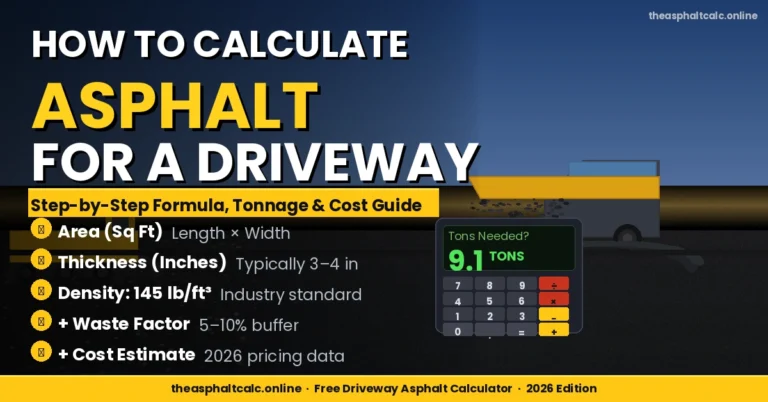
Most residential driveways fall in the 3–10 ton range depending on size and thickness. A standard 20×40 ft driveway at 2.5 inches compacted depth needs approximately 7.5 tons before waste. Use the Asphalt Driveway Calculator for your exact dimensions.
How much does 1 ton of asphalt cover at 2 inches thick?
At 2 inches compacted thickness, 1 ton of hot mix asphalt covers approximately 80 square feet (about 9 square yards). Based on standard HMA density of 145 lb/ft³.
How much does 1 ton of asphalt cover at 3 inches thick?
At 3 inches compacted thickness, 1 ton covers approximately 55 square feet (about 6 square yards).
How much does 1 ton of asphalt cover at 4 inches thick?
At 4 inches compacted thickness, 1 ton covers approximately 40–41 square feet (about 4.5 square yards).
How far does a ton of asphalt go?
It depends entirely on thickness. At 2 inches: ~80 sq ft. At 3 inches: ~55 sq ft. At 4 inches: ~41 sq ft. See the full coverage-per-ton table at the top of this guide.
What is asphalt coverage per ton?
Coverage per ton varies by thickness: 1.5 in = ~110 sq ft, 2 in = ~80 sq ft, 2.5 in = ~64 sq ft, 3 in = ~55 sq ft, 4 in = ~41 sq ft. All figures based on 145 lb/ft³ HMA density.
How thick should my asphalt driveway be?
For most residential driveways with passenger vehicles, 2–3 inches of compacted HMA over a prepared gravel base is standard. Go to 3 inches or more if you regularly park trucks, trailers, or heavy vehicles. See the full thickness guide.
How to calculate asphalt quantity in tons from square feet?
Tons = (Sq ft × Thickness in inches ÷ 12 × 145) ÷ 2000. Then add 5–10% for waste. For a step-by-step walkthrough, see our guide on how to calculate asphalt quantity.
How is asphalt measured?
Asphalt is measured and sold by weight — in US short tons (2,000 lb) in North America, or metric tonnes (1,000 kg) in the UK and Europe. Volume is often expressed in cubic yards during estimation, but orders are placed by the ton.
How do I convert asphalt square yards to tons?
Tons = (Sq yd × 9 × Thickness in inches ÷ 12 × 145) ÷ 2000. Quick reference: at 3 inches thick, every 100 sq yd needs approximately 16.6 tons.
How much asphalt do I need after a trench?
Use the saw-cut patch width, not the trench width, and add 10% waste. For a full worked example, see the trench patch section above.
What density should I use for hot mix asphalt (HMA)?
Use 145 lb/ft³ as a reliable planning default. The typical in-place range is 142–148 lb/ft³ depending on mix design and compaction. Get the actual figure from your supplier for large projects.
Final Checklist Before You Order
Still not sure? Run your numbers through the free asphalt calculator and get instant results — no signup required.
Last updated: April 2026 | Based on standard HMA density values per NAPA industry guidelines