How to Calculate Asphalt Quantity for Any Paving Project
You’ve got a paving project in front of you — and the first thing standing between you and getting started is one critical question: how much asphalt do I actually need?
Get this wrong, and you’re either running short mid-job — paying emergency delivery premiums and losing days of progress — or you’ve ordered hundreds of dollars worth of excess hot mix that ends up wasted. Both outcomes are expensive. Both are avoidable.
Learning how to calculate asphalt quantity correctly takes about five minutes, a tape measure, and a straightforward formula that professional contractors use every day. This guide covers everything: the core asphalt tonnage formula, step-by-step calculations for driveways, parking lots, and roads, thickness recommendations by project type, density values for different mixes, compaction and waste factors, and how to handle circular or irregular paving areas.
Whether you’re a homeowner estimating a residential driveway, a GC planning a commercial parking lot, or a civil engineer working on a highway pavement project — this is the only asphalt quantity guide you’ll need.
🧮 Want the instant answer? Use our free Asphalt Calculator → — no signup, no fees, results in seconds.
What Is Asphalt and Why Accurate Estimation Matters
Asphalt pavement — also called hot mix asphalt (HMA), blacktop, tarmac, or bitumen pavement — is a composite paving material made from coarse and fine aggregates (crushed rock, gravel, sand) bound together by bitumen, a petroleum-derived binder. It is the dominant paving material in the United States, covering approximately 94% of the country’s 2.6 million paved roads.
Beyond roads, asphalt finds application in driveways, parking lots, airport runways, bicycle lanes, sport courts, and industrial pads.
Why Getting the Quantity Right Is Non-Negotiable
Inaccurate asphalt material estimation leads to real problems:
- Under-ordering causes project delays, emergency reorders, and inconsistent batch color/texture between loads
- Over-ordering wastes budget and increases disposal costs
- Incorrect depth estimates result in pavement failure, cracking, and costly rework within 2–3 years
- Ignoring compaction means your surface layer ends up thinner than spec — a code violation on commercial jobs
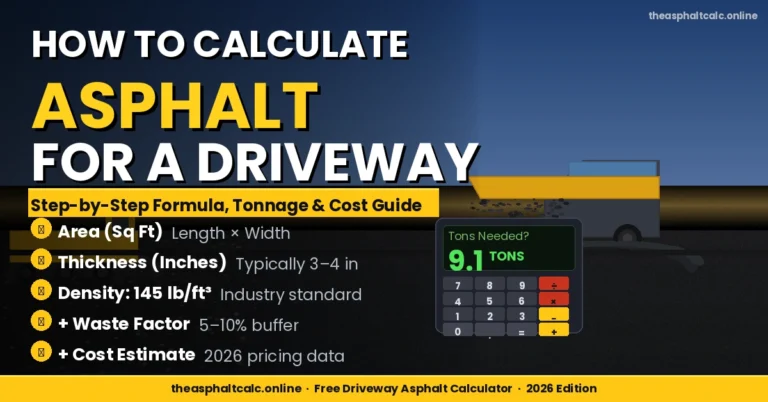
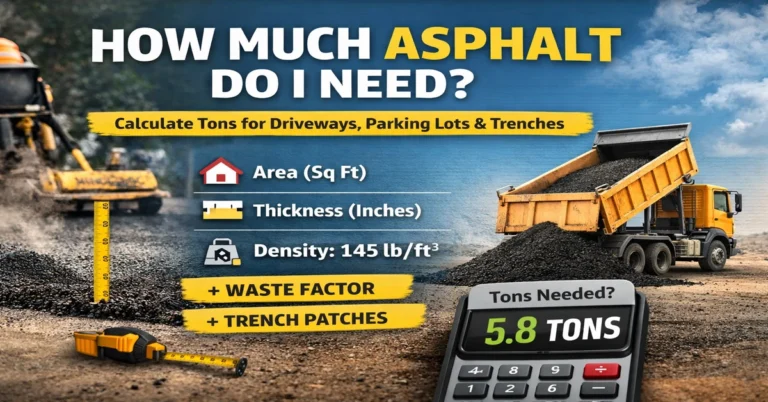
The good news: asphalt quantity calculation is not complex. You need three inputs — length, width, and depth — and a density constant. Everything else flows from there.
The Master Asphalt Quantity Formula (Step-by-Step)
This is the industry-standard asphalt quantity formula used by contractors, estimators, and paving engineers across the U.S.:
Step 1 — Calculate Asphalt Volume (Cubic Feet)
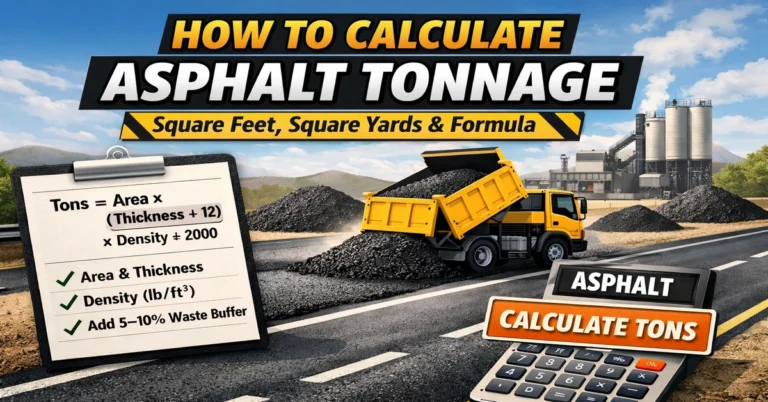
Volume (ft³) = Length (ft) × Width (ft) × Depth (ft)
⚠️ Always convert your depth from inches to feet before calculating. Divide inches by 12.
| Depth in Inches | Depth in Feet |
|---|---|
| 1 inch | 0.083 ft |
| 2 inches | 0.167 ft |
| 3 inches | 0.250 ft |
| 4 inches | 0.333 ft |
| 6 inches | 0.500 ft |
| 8 inches | 0.667 ft |
Step 2 — Convert Volume to Weight (Pounds)
Weight (lbs) = Volume (ft³) × 145
The number 145 is the standard hot mix asphalt density in lbs per cubic foot — the value used across the U.S. paving industry. This equals approximately 2,322 kg/m³.
Step 3 — Convert Weight to Tons
Tons = Weight (lbs) ÷ 2,000
Step 4 — Apply the Compaction and Waste Buffer
Final Order Quantity = Calculated Tons × 1.10 to 1.15
This accounts for the 8–10% volume reduction from asphalt compaction during roller passes, plus a 5–6% asphalt waste factor from edge trimming, hauling loss, and measurement variation.
The complete formula in one line:
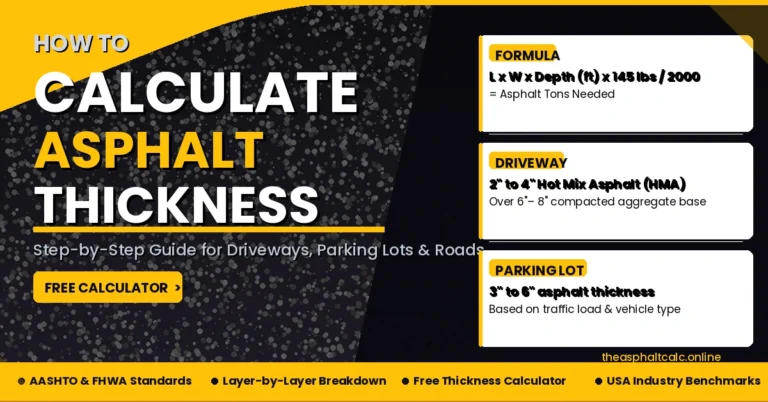
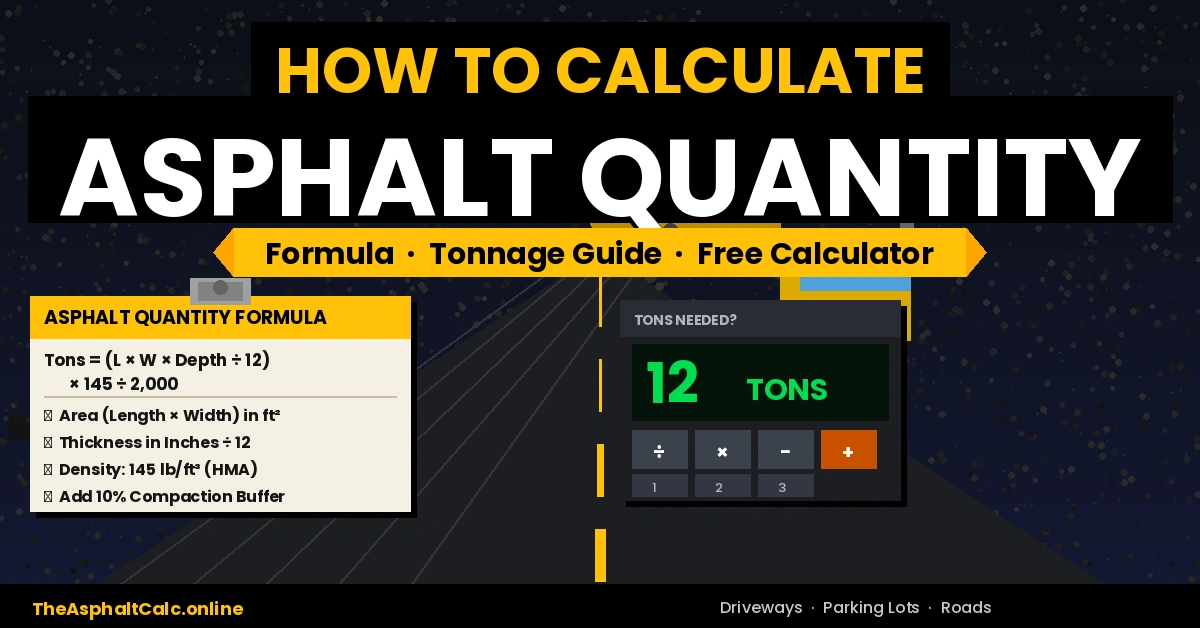
Tons = [(L × W × D) × 145] ÷ 2,000 × 1.10
Fully Worked Example — Residential Driveway
Project specs: Driveway — 50 feet long, 12 feet wide, 3-inch depth
| Step | Calculation | Result |
|---|---|---|
| Convert depth | 3 ÷ 12 | 0.25 ft |
| Volume | 50 × 12 × 0.25 | 150 ft³ |
| Weight | 150 × 145 | 21,750 lbs |
| Tonnage | 21,750 ÷ 2,000 | 10.875 tons |
| With 10% buffer | 10.875 × 1.10 | ~12 tons to order |
That’s the full asphalt tonnage calculation for a standard residential driveway. Clean, fast, accurate.
How to Calculate Asphalt Quantity in Different Units
Depending on your supplier, project specs, or estimating software, you may need asphalt quantities in different units. Here’s how to handle each one.
How to Calculate Asphalt Volume in Cubic Yards
Many asphalt suppliers in the U.S. price by the cubic yard. Convert using:
Cubic Yards = (Length × Width × Depth in feet) ÷ 27
Then convert to tons:
Tons = Cubic Yards × 2.025
(Standard asphalt density = approximately 2.025 tons per cubic yard)
Example — 100 ft × 50 ft parking lot at 4 inches deep:
| Step | Calculation | Result |
|---|---|---|
| Volume (ft³) | 100 × 50 × 0.333 | 1,665 ft³ |
| Volume (yd³) | 1,665 ÷ 27 | 61.67 yd³ |
| Tonnage | 61.67 × 2.025 | ~124.9 tons |
| With 10% buffer | 124.9 × 1.10 | ~137.4 tons to order |
How to Calculate Asphalt in Square Yards (SY)
The asphalt square yards method is one of the fastest approaches for experienced contractors:
Tons = Area (SY) × Depth (inches) × 0.057
The 0.057 conversion factor (tons per SY per inch of depth) is the U.S. paving industry standard derived from Quora paving engineers and field contractors.
Example — 1,200 SY at 3-inch depth:
1,200 × 3 × 0.057 = 205.2 tons
To convert sq ft to sq yards: divide sq ft by 9
How to Calculate Square Footage for Paving Asphalt
You need your asphalt area calculation first. Here’s how to measure different shapes:
| Shape | Formula |
|---|---|
| Rectangle / Square | Length × Width |
| Triangle | (Base × Height) ÷ 2 |
| Circle | π × radius² (3.14159 × r²) |
| Trapezoid | ((Side A + Side B) ÷ 2) × Height |
| Irregular shape | Divide into rectangles/triangles, calculate each, sum totals |
Pro tip: For accurate measurements on curved or irregular driveways, use a measuring wheel on-site. Estimating from satellite maps or Google Earth consistently under-reads perimeter edges and produces 5–15% errors.
How to Calculate Asphalt for a Circle (Radius Method)
Circular turnarounds, roundabouts, cul-de-sacs, and curved decorative pads require a slightly different area calculation:
Area (ft²) = π × r²
Where r = radius in feet and π = 3.14159
Example — 20-foot radius circular driveway pad at 3-inch depth:
| Step | Calculation | Result |
|---|---|---|
| Area | 3.14159 × (20²) | 1,256.6 ft² |
| Volume | 1,256.6 × 0.25 ft | 314.15 ft³ |
| Weight | 314.15 × 145 | 45,552 lbs |
| Tonnage | 45,552 ÷ 2,000 | 22.8 tons |
| With buffer | 22.8 × 1.10 | ~25 tons to order |
Asphalt Thickness Guide — What Depth Do You Actually Need?
Asphalt layer thickness is the single most misunderstood variable in the entire calculation. Using the wrong depth doesn’t just mess up your tonnage estimate — it leads to structural pavement failure, cracking under load, and void warranty claims from your supplier.
Here’s the authoritative thickness reference table used across U.S. paving projects:
| Project Type | Traffic Load | Recommended Depth | Notes |
|---|---|---|---|
| Residential driveway (passenger cars) | Light | 3 inches minimum | 4″ recommended in cold climates |
| Residential driveway (RVs/trucks) | Medium | 4–5 inches | Add reinforced base |
| Private parking lot | Light | 3–4 inches | Standard for up to 50 cars |
| Commercial parking lot | Medium | 4–6 inches | Dense-graded HMA required |
| Heavy-duty parking / truck yard | Heavy | 6–8 inches | Multiple lift layers |
| Municipal road / local street | Medium | 4–6 inches | Base course + surface course |
| Highway pavement | Very Heavy | 8–12 inches | Engineered multi-lift design |
| Bicycle lane / pedestrian path | Minimal | 1.5–2 inches | Open-graded fine mix |
| Airport taxiways / aprons | Extreme | 12–24 inches | Specialist pavement engineering |
What most people miss: On projects thicker than 4 inches, asphalt is always applied in multiple lifts (layers). A typical two-lift design might use a 4-inch compacted base course and a 2-inch surface course. Calculate each lift separately — they often use different asphalt mix designs with different densities.
Asphalt Density — Which Value Should You Use?
Your asphalt density value directly controls the accuracy of every tonnage calculation. Use the wrong density and you’re off by 5–15% on every number downstream.
| Asphalt Mix Type | Typical Density (lbs/ft³) | Typical Density (kg/m³) | Common Use |
|---|---|---|---|
| Standard Hot Mix Asphalt (HMA) | 145 | 2,322 | Most driveways and roads |
| Dense-Graded HMA | 148–150 | 2,370–2,400 | Heavy-traffic roads, parking lots |
| Open-Graded / Porous Asphalt | 120–130 | 1,920–2,080 | Stormwater drainage paving |
| Warm Mix Asphalt (WMA) | 142–146 | 2,272–2,338 | Eco-friendly alternative to HMA |
| Cold Mix Asphalt | 125–135 | 2,000–2,160 | Patching, repairs |
| Reclaimed Asphalt Pavement (RAP) | 130–140 | 2,080–2,240 | Recycled pavement, varies by blend |
Industry best practice: Always call your local asphalt plant and request the exact mix density for the product you’re ordering before finalizing your tonnage estimate. This is especially critical for specialty mixes, high-RAP blends, or polymer-modified asphalt used in performance applications.
Use 145 lbs/ft³ as your standard default for budgeting and early-stage estimates.
Compaction Factor and Waste Factor — Don’t Skip This Section
This is where most DIYers and first-time estimators get burned.
Asphalt Compaction Factor
When hot mix asphalt leaves the plant, it’s a loose, airy material. Once the vibratory roller passes over it, the mix compresses — typically by 8–12% depending on lift thickness, temperature, and roller type.
This means if you calculate you need 100 tons of loose mix, you actually need 110–112 tons to end up with 100 tons of compacted surface.
Rule: Always apply a minimum 10% compaction factor to your base tonnage.
Asphalt Waste Factor
Beyond compaction, real-world paving projects have unavoidable material losses:
- Trimming and cutting at edges and curbs
- Spillage during hauling and transfer
- Truck tailgate loss
- Irregular boundary overbreak
Standard industry recommendation: add 5–6% for waste. On complex or high-precision commercial jobs where material cost is significant, use a combined overhead of 12–15%.
| Project Type | Recommended Total Buffer |
|---|---|
| Simple rectangular driveway | 10% |
| Curved or irregular driveway | 12–15% |
| Parking lot with landscaping islands | 12–15% |
| Road with drainage inlets/cuts | 15% |
| Multi-layer highway construction | 10–12% per lift |
Project-by-Project Asphalt Quantity Examples
Asphalt Driveway Calculator — Residential Estimation
The most common residential specs in the U.S.:
- Single-car driveway: 10–12 ft wide, 20–50 ft long
- Double-car driveway: 18–24 ft wide, 30–60 ft long
- Recommended depth: 3 inches minimum; 4 inches for cold climates or heavier vehicles
Quick reference — tons needed at 3-inch depth:
| Driveway Size (ft) | Area (sq ft) | Estimated Tons (no buffer) | Tons to Order (+10%) |
|---|---|---|---|
| 10 × 20 | 200 | 3.6 | ~4 tons |
| 12 × 40 | 480 | 8.7 | ~9.6 tons |
| 12 × 50 | 600 | 10.9 | ~12 tons |
| 20 × 40 | 800 | 14.5 | ~16 tons |
| 24 × 60 | 1,440 | 26.1 | ~29 tons |
Use our Asphalt Driveway Calculator for custom dimensions — instant results.
Asphalt Parking Lot Calculation
Commercial asphalt parking lot estimation involves higher tonnage, more complex shapes, and heavier-duty mix requirements. Standard specs for a medium-density commercial lot:
- Surface course: 2-inch HMA wearing surface
- Base course: 4-inch dense-graded HMA
- Aggregate base: 6–8 inches compacted crushed stone or gravel
Example — 200 ft × 100 ft commercial parking lot, 4-inch total depth:
| Step | Calculation | Result |
|---|---|---|
| Area | 200 × 100 | 20,000 sq ft |
| Volume | 20,000 × 0.333 ft | 6,660 ft³ |
| Weight | 6,660 × 145 | 965,700 lbs |
| Tonnage | 965,700 ÷ 2,000 | 482.9 tons |
| With 12% buffer | 482.9 × 1.12 | ~541 tons to order |
Try our Parking Lot Asphalt Calculator →
Asphalt Road Quantity Calculation
For road construction estimation, engineers calculate by lane:
- Standard U.S. lane width: 12 feet
- Two-lane rural road: 24 feet wide
- Typical road asphalt thickness: 4–6 inches surface, 4–6 inches base course
Example — 1-mile (5,280 ft) two-lane road at 5-inch depth:
| Step | Calculation | Result |
|---|---|---|
| Area | 5,280 × 24 ft | 126,720 sq ft |
| Volume | 126,720 × 0.417 ft | 52,842 ft³ |
| Weight | 52,842 × 145 | 7,662,090 lbs |
| Tonnage | 7,662,090 ÷ 2,000 | 3,831 tons |
| With 10% buffer | 3,831 × 1.10 | ~4,214 tons to order |
Road projects require separate calculations for each layer (base course, binder course, surface course), tack coat between layers, and often a separate sub base aggregate estimate.
Asphalt Mix Types Explained — Which One to Use
Understanding asphalt mix design helps you select the right product and use the correct density value in your calculations. Here’s a quick breakdown:
Hot Mix Asphalt (HMA) — The industry standard. Produced at 300–350°F at the asphalt plant and must be laid immediately. Used for driveways, parking lots, roads, and highways. Highest structural strength.
Warm Mix Asphalt (WMA) — Similar to HMA but manufactured at lower temperatures (250–275°F). Fewer emissions, extended haul distances, and better workability in cooler weather. Increasingly common on urban paving contracts.
Cold Mix Asphalt — No heat required. Used for pothole patching, utility cut repairs, and emergency fixes. Not suitable for full-depth construction.
Porous / Open-Graded Asphalt — Designed with intentional void spaces (18–22% air voids) for stormwater drainage. Common in parking lots with environmental stormwater requirements. Lower density than standard HMA.
Reclaimed Asphalt Pavement (RAP) — Recycled material milled from existing pavements and blended back into new mix. Sustainable, cost-effective, and used in base course applications across the U.S.
Base Preparation — What Goes Under Your Asphalt
One detail that completely changes your asphalt paving material estimate is the subbase. Asphalt is a flexible pavement — it performs and lasts based almost entirely on what’s beneath it.
| Soil Type | Recommended Aggregate Base Depth |
|---|---|
| Sandy soil / good drainage | 4 inches compacted crushed gravel |
| Clay / poor drainage | 6–8 inches compacted crushed stone |
| Soft or unstable subgrade | Geotextile fabric + 8–12 inches base |
| Over existing concrete | 2-inch asphalt overlay (check condition) |
A well-prepared compacted gravel base means you can use a thinner asphalt layer and still achieve longer pavement life. Skipping this step is the #1 reason driveways and parking lots crack within 3–5 years.
Cost implication: Base material (crushed stone) typically runs $10–$30 per ton — significantly cheaper than asphalt at $100–$150 per ton. Investing in a proper base saves money long-term.
Asphalt Cost Reference — 2026 U.S. Pricing
Understanding asphalt cost per ton helps you build a complete material budget alongside your quantity estimate.
| Material | Price Range (2025 U.S. Average) |
|---|---|
| Hot Mix Asphalt (HMA) at plant | $80–$150 per ton |
| Delivered HMA (includes freight) | $100–$200 per ton |
| Cold Mix / Patch Asphalt (bagged) | $15–$30 per bag |
| Crushed stone/gravel base | $10–$30 per ton |
| Paving installation (labor + machine) | $3–$7 per sq ft installed |
| Asphalt sealcoating | $0.15–$0.35 per sq ft |
Note: Asphalt pricing fluctuates with crude oil prices. Costs vary by region, season, order volume, and access conditions. Always get three quotes from local suppliers before ordering.
Asphalt vs. Concrete — Quick Material Comparison
Many project planners compare both materials before deciding. Here’s how they stack up on the factors relevant to estimation and quantity planning:
| Factor | Asphalt Pavement | Concrete Pavement |
|---|---|---|
| Material cost per sq ft | $0.75–$2.00 | $3.00–$10.00 |
| Installation cost | $3–$7/sq ft | $6–$12/sq ft |
| Ready for traffic | Immediately | 7–28 days cure time |
| Lifespan (maintained) | 20–30 years | 30–50 years |
| Freeze/thaw performance | Excellent (flexible) | Poor (brittle, cracks) |
| Repairability | Easy (patch, overlay) | Difficult |
| Recyclability | 100% recyclable (RAP) | Limited |
| Stormwater runoff | Porous option available | Impervious (standard) |
For most residential driveways and commercial parking lots in the United States, hot mix asphalt remains the first choice due to lower upfront cost, immediate use after laying, excellent performance in cold climates, and ease of repair.
Using Our Free Asphalt Calculator — The Smart Way to Estimate
Manual calculations work perfectly fine — but for repeat estimating across multiple project areas, irregular shapes, or when you need to present a fast quote to a client, our free Asphalt Calculator at TheAsphaltCalc.online saves significant time.
Here’s what it handles:
- Rectangular driveways, parking lots, and roads
- Instant asphalt tonnage from length, width, and depth inputs
- Volume in cubic feet and cubic yards
- U.S. customary units (feet, inches)
- Real-time results — no account, no cost
👉 Calculate Your Asphalt Quantity Now — It’s Free →
Common Mistakes That Cause Wrong Asphalt Estimates
After reviewing hundreds of paving project forum threads, Reddit discussions, and contractor Q&As, these are the most common errors:
1. Forgetting to convert inches to feet Depth in the formula must be in feet. 3 inches = 0.25 ft — not 3. This single mistake inflates your estimate by 12x.
2. Ignoring the compaction factor Loose asphalt compresses under roller pressure. Every estimate needs at least 10% added before ordering.
3. Using one thickness for all layers Multi-lift projects need separate tonnage calculations per layer. A 6-inch total depth is not the same as one calculation at 6 inches — it’s a base course + surface course with potentially different mix densities.
4. Not confirming mix density with your plant Dense-graded HMA, porous asphalt, and recycled blends all have different densities. Using 145 lbs/ft³ for porous asphalt (which is ~125 lbs/ft³) will result in a significant over-order.
5. Estimating irregular shapes as rectangles Curved driveways, kidney-shaped parking lots, and roads with tapers are never true rectangles. Divide them into regular shapes, calculate each section, then sum them.
6. Forgetting the subbase in the total project cost The asphalt tonnage is only part of the material cost. A proper aggregate base layer is non-negotiable and must be estimated separately.
Frequently Asked Questions (FAQs)
How do I calculate how much asphalt I need for a driveway?
Measure the length, width, and planned depth in feet (convert inches to feet by dividing by 12). Multiply all three together for cubic feet. Multiply by 145 for pounds. Divide by 2,000 for tons. Add 10% for compaction. For a 12 × 50 ft driveway at 3 inches deep, you need approximately 12 tons.
How many tons of asphalt does one square foot require?
At 1-inch depth, one square foot of standard HMA weighs about 0.053–0.060 tons. At 3 inches, multiply by three — roughly 0.15–0.18 tons per square foot. At 4 inches, expect approximately 0.20–0.24 tons per square foot.
What is the standard hot mix asphalt density used in the U.S.?
The U.S. industry standard is 145 lbs per cubic foot (2,322 kg/m³). Dense-graded mixes may be slightly heavier at 148–150 lbs/ft³. Confirm with your local asphalt plant when ordering specialty or recycled blends.
How do I calculate asphalt for a circular area?
Use Area = π × r² to find square footage, where r is the radius in feet. Then follow the standard volume → weight → tonnage formula. For a 20-foot radius circle at 3-inch depth, you’ll need approximately 25 tons including a 10% buffer.
How much does one ton of asphalt cover?
At 1-inch depth, 1 ton covers roughly 80 square feet. At 2 inches, approximately 40 sq ft. At 3 inches, about 26–27 sq ft. In square yards: approximately 8.7 SY at 2-inch depth per ton.
Should I always add extra asphalt for compaction?
Yes — always. A minimum 10% compaction buffer is standard. For irregular shapes, curved edges, or multi-layer projects, increase that buffer to 12–15%. Running short mid-project is far more costly than having a small surplus.
Conclusion
Calculating asphalt quantity comes down to three measurements — length, width, and depth — combined with an accurate density constant and a realistic buffer for compaction and waste. Master the formula, respect the thickness requirements for your specific project type, and always confirm your mix density with your supplier. For any project — driveway, parking lot, or road — our free Asphalt Calculator delivers your tonnage, volume, and coverage estimate in seconds.