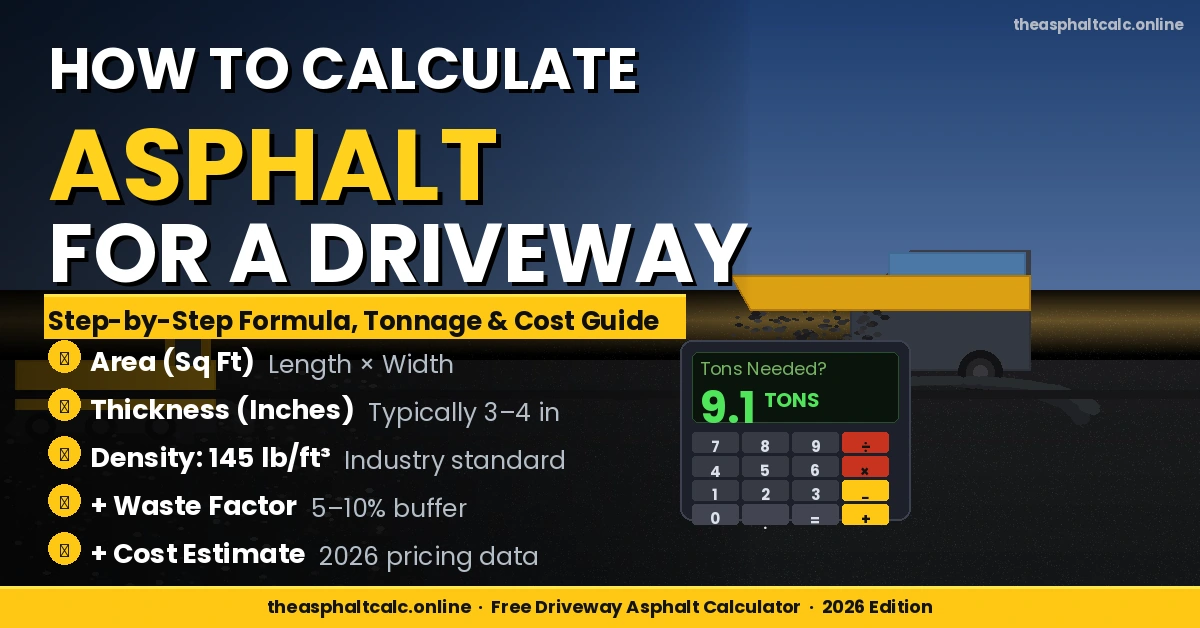
How to Calculate Asphalt for a Driveway
Figuring out how to calculate asphalt for a driveway seems simple — until you’re standing in your yard with a tape measure, wondering why every estimate you find online gives you a different number.
Too little asphalt and your contractor runs short mid-pour, costing you an emergency delivery charge. Too much and you’ve paid for tons of material sitting in a dump truck with nowhere to go. Getting this right upfront isn’t just a math exercise — it directly determines what you pay and whether your driveway lasts 5 years or 25.
This guide gives you the same formula professional paving contractors use, complete with real worked examples, a thickness decision guide, a coverage quick-reference table, and updated cost data for 2026. By the end, you’ll know exactly how many tons to order and how to verify any quote a contractor gives you.
Want your answer in seconds? → Use our free Asphalt Driveway Calculator — enter your measurements and get instant tonnage, volume, and estimated cost.
The Core Formula: How Do You Calculate Asphalt for a Driveway?
The industry-standard formula used by paving contractors across the United States converts your driveway measurements into tons of asphalt — which is how hot mix asphalt (HMA) is sold and priced. Here is the complete step-by-step breakdown.
Step 1 — Calculate Your Driveway’s Square Footage
Square Footage = Length (ft) × Width (ft)Step 2 — Convert Asphalt Thickness from Inches to Feet
Asphalt depth is specified in inches but the formula requires feet.
Thickness in Feet = Desired Depth (inches) ÷ 12Step 3 — Calculate Volume in Cubic Feet
Volume (ft³) = Square Footage × Thickness (ft)Step 4 — Convert Volume to Weight in Pounds
Hot mix asphalt has a standard compacted density of 145 lbs per cubic foot — the professional benchmark used by the Minnesota Asphalt Pavement Association and industry contractors nationwide.
Weight (lbs) = Volume (ft³) × 145Step 5 — Convert Pounds to Tons
Asphalt is sold by the short ton (2,000 lbs).
Tons = Weight (lbs) ÷ 2,000The Single Combined Formula
Once you understand each step, you can run the entire calculation at once:
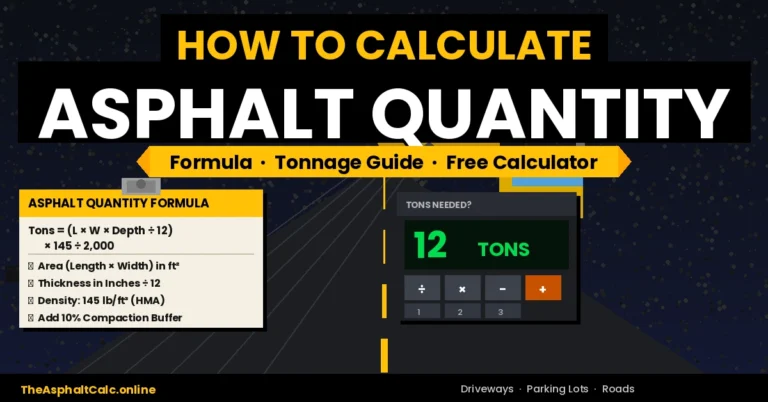
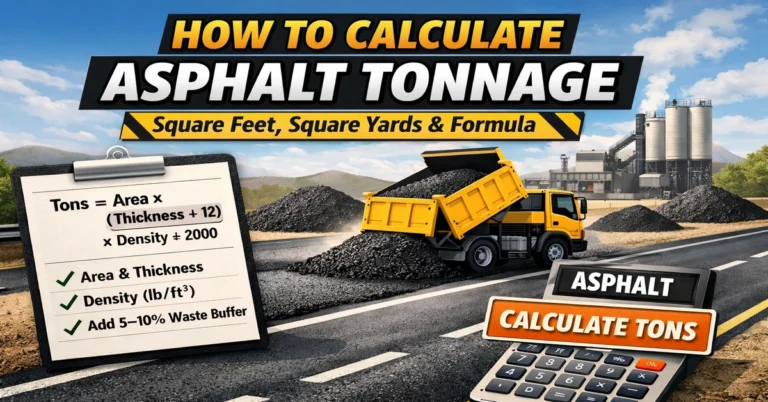
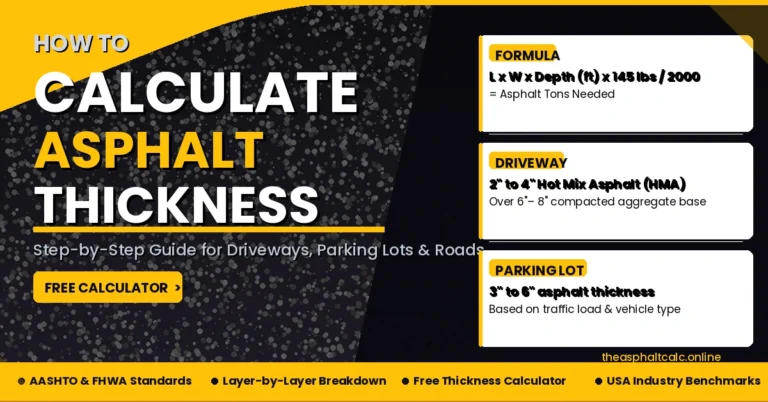
Tons = (Length × Width × (Thickness ÷ 12) × 145) ÷ 2,000Always add 5–10% to your final tonnage figure to account for compaction loss, edge trimming, and material handling waste before placing your order.
How to Calculate Square Footage for Asphalt — Every Driveway Shape
Most homeowners have a rectangular driveway, which makes square footage calculation straightforward. But not all driveways are perfectly rectangular, and this is where a lot of estimates go wrong.
Standard Rectangle: Length × Width. A 12-foot-wide by 60-foot-long driveway is 720 square feet.
L-Shaped Driveway: Divide it into two rectangles. Measure each section separately and add the results. If Section A is 10 × 40 ft (400 sq ft) and Section B is 20 × 20 ft (400 sq ft), your total is 800 square feet.
Curved or Irregular Driveway: Break the area into smaller sections with straight edges, calculate each one, and add them together. Use a 10% overage buffer to cover the imprecision in your estimates — curved edges make this unavoidable without CAD-level measurement.
Circular Turnaround at the End: Use the circle area formula — π × radius². If your turnaround has a 10-foot radius, that adds 314 square feet to your total.
For complex shapes, the easiest and most accurate approach is our Asphalt Driveway Calculator, which handles irregular layouts and outputs tonnage, volume in cubic yards, and estimated cost instantly.
Real Driveway Calculation Examples
Example 1 — Single-Car Driveway (10 ft × 50 ft, 3-inch depth)
| Step | Calculation | Result |
|---|---|---|
| Square footage | 10 × 50 | 500 sq ft |
| Thickness in feet | 3 ÷ 12 | 0.25 ft |
| Volume | 500 × 0.25 | 125 ft³ |
| Weight | 125 × 145 | 18,125 lbs |
| Base tonnage | 18,125 ÷ 2,000 | 9.06 tons |
| Order (+ 10% buffer) | 9.06 × 1.10 | ~10 tons |
Example 2 — Two-Car Driveway (20 ft × 40 ft, 4-inch depth)
| Step | Calculation | Result |
|---|---|---|
| Square footage | 20 × 40 | 800 sq ft |
| Thickness in feet | 4 ÷ 12 | 0.333 ft |
| Volume | 800 × 0.333 | 266 ft³ |
| Weight | 266 × 145 | 38,570 lbs |
| Base tonnage | 38,570 ÷ 2,000 | 19.3 tons |
| Order (+ 10% buffer) | 19.3 × 1.10 | ~21 tons |
Example 3 — Long Rural Driveway (12 ft × 120 ft, 3-inch depth)
| Step | Calculation | Result |
|---|---|---|
| Square footage | 12 × 120 | 1,440 sq ft |
| Thickness in feet | 3 ÷ 12 | 0.25 ft |
| Volume | 1,440 × 0.25 | 360 ft³ |
| Weight | 360 × 145 | 52,200 lbs |
| Base tonnage | 52,200 ÷ 2,000 | 26.1 tons |
| Order (+ 10% buffer) | 26.1 × 1.10 | ~29 tons |
Asphalt Tonnage Quick-Reference Table
Use this table to cross-check your calculations or get a fast ballpark estimate without doing the math manually.
| Driveway Size | Sq Footage | Tons at 2″ | Tons at 3″ | Tons at 4″ |
|---|---|---|---|---|
| 10 ft × 20 ft | 200 sq ft | 3.0 | 4.5 | 6.1 |
| 10 ft × 50 ft | 500 sq ft | 7.3 | 10.9 | 14.5 |
| 12 ft × 40 ft | 480 sq ft | 7.0 | 10.4 | 13.9 |
| 16 ft × 40 ft | 640 sq ft | 9.3 | 13.9 | 18.6 |
| 20 ft × 40 ft | 800 sq ft | 11.6 | 17.4 | 23.2 |
| 20 ft × 60 ft | 1,200 sq ft | 17.4 | 26.1 | 34.8 |
| 24 ft × 60 ft | 1,440 sq ft | 20.9 | 31.3 | 41.7 |
Add 5–10% to all figures above before ordering.
Asphalt Thickness Guide: How Thick Should a Driveway Be?
Thickness is the variable most homeowners underestimate — and getting it wrong is more expensive to fix than getting it right the first time. A driveway installed at inadequate depth might last 5 to 7 years instead of the 15 to 20 years a properly built surface delivers.
Four factors drive the correct thickness for your specific driveway: vehicle load, soil type, climate zone, and whether you’re doing a new install or an overlay over existing pavement.
| Application | Recommended Thickness | Notes |
|---|---|---|
| Light residential (1–2 passenger cars) | 2–3 inches | Minimum for standard use |
| Heavy vehicle / trailer / RV parking | 3–4 inches | Prevents rutting and concentrated load damage |
| Cold climate (freeze-thaw zones) | 4–6 inches full-depth | Reduces frost heave cracking significantly |
| Sandy soil subgrade | 3 inches + 4″ gravel base | Sandy soil drains well but needs a stable base |
| Clay soil subgrade | 3 inches + 8″ compacted gravel base | Clay retains water — a deeper base is non-negotiable |
| Driveway overlay / resurfacing | 1.5–2 inches | Only viable if existing base is structurally sound |
| Light-duty parking lot | 4–5 inches | |
| Heavy truck / commercial traffic | 7–8 inches |
The Two-Layer Installation System
Professional paving contractors don’t just pour asphalt in a single layer. A standard residential install uses a 2-inch binder course (coarser aggregate mix for structural depth) topped by a 1-inch surface/wearing course (finer aggregate for a smooth, durable finish). This two-layer approach maximizes load distribution and extends pavement life compared to a single pour.
In cold-weather states — Minnesota, Wisconsin, Michigan, upstate New York, Maine, Colorado — the industry consensus is to go with 4 to 6 inches of full-depth asphalt. Freeze-thaw cycles apply enormous upward pressure on pavement from below. Thin driveways crack and heave in these climates almost inevitably within a few years.
The Compaction Factor — Why You Must Always Order Extra
Here’s something most online guides skip entirely: when hot mix asphalt is compacted by a roller, it loses 8 to 12% of its uncompacted volume. This is physical compaction of the mix — it’s not waste, it’s the entire point of rolling. But it means the volume you measure out is not the volume you end up with on the ground.
On top of compaction loss, you lose additional material to edge finishing, handling, and minor measurement imprecision. The result is that your calculated tonnage will always fall short of what you actually need if you don’t account for it.
Professional standard: Add a minimum of 5% waste factor for small driveways and 10% for driveways with irregular shapes, slopes, or multiple sections. If your calculation says 20 tons, order 22. A short delivery on a hot mix job doesn’t just mean a phone call — it can mean your crew standing idle while material cools and your window for a clean finish closes.
How Much Does 1 Ton of Asphalt Cover?
One of the most searched questions on this topic — and the answer depends entirely on thickness. Here’s the coverage breakdown using the standard 145 lbs/ft³ density:
| Asphalt Thickness | Coverage Per Ton |
|---|---|
| 1 inch | ~160 sq ft |
| 1.5 inches | ~107 sq ft |
| 2 inches | ~80 sq ft |
| 3 inches | ~53 sq ft |
| 4 inches | ~40 sq ft |
| 6 inches | ~27 sq ft |
Quick rule of thumb for residential driveways (3-inch standard): One ton of compacted hot mix asphalt covers approximately 50–55 square feet. If a contractor tells you otherwise by a large margin, that’s worth questioning.
How to Calculate the Cost of an Asphalt Driveway
Once you have your tonnage number, estimating total project cost is a two-part equation: material cost plus installation cost.
Asphalt Material Cost (2026 Pricing)
Hot mix asphalt currently costs between $100 and $200 per ton for residential-grade blacktop in most U.S. markets, reflecting recent fluctuations in crude oil prices and aggregate availability. Recycled asphalt pavement (RAP) comes in significantly lower at $10 to $20 per ton and is a viable option for base layers on budget-conscious projects.
Material Cost = Tons Needed × Local Price Per TonFor a 20-ton order at $150/ton — $3,000 in material cost alone, before labor, base preparation, or delivery.
Full Installed Cost Breakdown (2026 National Averages)
According to Angi’s 2026 pricing data, most homeowners pay between $7 and $15 per square foot installed, with the average asphalt driveway project running around $5,269 nationally.
| Cost Component | Typical Range (2026) |
|---|---|
| New asphalt installation | $7–$13 per sq ft |
| Full driveway replacement | $8–$15 per sq ft |
| Asphalt overlay / resurfacing | $3–$7 per sq ft |
| Labor only | $5–$7 per sq ft |
| Gravel/aggregate base material | $0.65 per sq ft |
| Existing driveway removal | $1–$3 per sq ft |
| Subgrade excavation & grading | $1–$8 per sq ft |
| Tack coat (bonding layer) | Typically included in labor |
| Sealcoating (recommended at 90 days) | $0.15–$0.25 per sq ft |
| Typical total residential project | $3,000–$10,000 |
Regional pricing matters significantly. Urban metros and high cost-of-living states like California, New York, and Massachusetts command prices near the top of these ranges. Rural areas in the Midwest and South typically land at the lower end.
Get a precise material cost estimate → Run your dimensions through our Asphalt Driveway Calculator and see tonnage plus estimated material cost before you talk to a single contractor.
Types of Asphalt Used for Driveways
Understanding the material your contractor is using — and quoting — prevents you from comparing apples to oranges when reviewing bids.
Hot Mix Asphalt (HMA) is the professional standard for residential and commercial driveways. Mixed and applied at 300–350°F, it produces a dense, durable pavement surface with excellent water resistance and load-bearing capacity. This is what virtually every paving contractor in the U.S. uses for new driveway installations.
Blacktop is a specific hot mix formulation with a higher proportion of crushed stone and sand. It’s slightly more flexible than standard HMA and is the go-to choice for most residential applications, offering the best balance of cost and durability for passenger vehicle loads.
Warm Mix Asphalt (WMA) is produced at lower temperatures than HMA, resulting in reduced emissions and fuel use during production. It performs comparably to HMA in most residential applications and is increasingly favored on environmentally sensitive projects.
Recycled Asphalt Pavement (RAP) incorporates reclaimed asphalt material from old roads and driveways, crushed and reprocessed into new pavement. It costs significantly less — $10 to $20 per ton for base-layer applications — and is a legitimate option for homeowners managing a tight budget, though it may not match the long-term surface quality of fresh HMA.
Porous Asphalt is engineered with a high void content to allow stormwater to drain through the surface, reducing runoff. It costs more upfront — roughly $3 to $8 per sq ft for materials — but eliminates the need for complex drainage infrastructure on sites with stormwater management requirements.
Cold Mix Asphalt is a non-heated, premixed patching material. It’s designed for crack repairs and pothole patching only — not for full driveway installation. Never accept cold mix as a base for a new driveway pour.
What Else Affects How Much Asphalt You Need?
The formula gives you a baseline tonnage — but these real-world variables can push your actual material requirement up or down meaningfully.
Soil type and subgrade strength are arguably the biggest hidden variables. Clay-heavy soil retains water and expands seasonally, requiring an 8-inch compacted gravel base beneath your asphalt to prevent subgrade failure. Sandy, well-draining soil needs only a 4-inch base. Skipping proper base preparation is the single most common reason driveways fail well before their expected lifespan — and no amount of asphalt thickness compensates for an unstable subgrade.
Driveway grade and slope affect both material calculation and installation. Steep slopes require slightly higher tonnage to account for material runoff during placement, and they demand more careful compaction technique to prevent surface irregularities.
Vehicle type and parking behavior change your thickness requirements directly. If you regularly park a boat trailer, RV, camper, or heavy pickup truck in the driveway, design for 3 to 4 inches minimum. The concentrated loads from trailer tongue jacks and outrigger pads will sink a standard 2-inch driveway within a season or two.
Climate zone influences both thickness selection and long-term performance dramatically. In states experiencing significant freeze-thaw cycles — Minnesota, Michigan, Wisconsin, New England, Colorado, the Dakotas — a 4 to 6-inch full-depth asphalt section is the smart long-term investment. The upfront material cost increase of 30–35% can double or triple the driveway’s useful life in these environments.
Overlay vs. full replacement changes your depth requirement entirely. If you’re resurfacing an existing driveway in good structural condition, 1.5 to 2 inches of new surface course is often sufficient. If the existing base is compromised, cracked through, or experiencing subgrade movement, a full tear-out and replacement is the only correct approach — and overlaying a failing base is money thrown away.
Asphalt Driveway Lifespan and Maintenance
A properly installed asphalt driveway lasts 15 to 25 years with routine maintenance — and significantly less without it. Two maintenance tasks have the most impact on longevity:
Sealcoating should be applied approximately 90 days after new installation, then every 2 to 3 years thereafter. Sealcoating protects the pavement surface from UV oxidation, water infiltration, fuel and oil spills, and temperature cycling. Cost runs $0.15 to $0.30 per square foot per application — a fraction of what resurfacing costs.
Crack filling should be addressed immediately when hairline cracks appear. Water penetrates through cracks, freezes, and expands, accelerating deterioration from below. Small cracks that cost $1 to $3 per square foot to fill today become structural failures requiring full-depth patching or replacement at $8 to $15 per square foot if ignored.
Asphalt vs. Concrete: Which Is Better for a Driveway?
This is one of the most common secondary questions homeowners search after calculating asphalt tonnage, so it’s worth a direct answer.
| Factor | Asphalt | Concrete |
|---|---|---|
| Installed cost per sq ft | $7–$13 | $10–$18 |
| Typical lifespan | 15–25 years | 25–40 years |
| Cold climate performance | Excellent (flexible) | Fair (can crack at joints) |
| Hot climate performance | Fair (can soften) | Excellent |
| Repair cost | Low–Moderate | High |
| Maintenance requirement | Sealcoating every 2–3 yrs | Minimal sealing needed |
| Time to use after install | 24–48 hours | 5–7 days curing |
Asphalt wins on upfront cost, cold climate performance, and repairability. Concrete wins on lifespan and low ongoing maintenance in warm climates. For most U.S. homeowners, especially in northern states, asphalt is the practical and economical choice — which is why it covers approximately 94% of the country’s 2.6 million paved roads.
Frequently Asked Questions
How do you calculate asphalt for a driveway?
Multiply your driveway’s length × width to get square footage. Divide your desired asphalt thickness in inches by 12 to get thickness in feet. Multiply square footage × thickness × 145 (lbs/ft³) to get total weight in pounds, then divide by 2,000 to convert to tons. Add 5–10% for compaction and waste before ordering.
How much asphalt do I need for a 1,000 sq ft driveway?
At 3 inches thick, you need approximately 18–19 tons before waste. At 4 inches thick, approximately 24–25 tons. Always add at least 5% to your calculated tonnage before placing a material order.
How do I calculate the cost of an asphalt driveway?
Multiply your calculated tonnage by your local asphalt price per ton ($100–$200 in most 2026 U.S. markets) for material cost. For total installed cost, budget $7 to $13 per square foot including labor and base preparation on a new install. A typical residential driveway runs $3,000 to $10,000 depending on size, region, and site conditions.
What is the minimum thickness for a residential asphalt driveway?
The industry minimum is 3 inches total depth — ideally installed as a 2-inch binder course plus a 1-inch surface/wearing course. In cold climates with significant freeze-thaw cycles, 4 to 6 inches full-depth asphalt is strongly recommended to prevent premature frost heave cracking.
How do I calculate square footage for an asphalt driveway?
For a rectangular driveway, multiply length × width. For L-shaped driveways, split into two rectangles and add the results. For curved or irregular shapes, divide into sections, calculate each separately, and add a 10% buffer for measurement imprecision.
Does asphalt density vary by mix type?
Yes, though not dramatically for planning purposes. The standard hot mix asphalt density for residential driveways ranges from 142 to 148 lbs per cubic foot, with 145 lbs/ft³ being the professional planning standard. If your supplier uses a specialized mix, ask them for their specific compacted density and use that figure in your calculation for greater accuracy.
Conclusion
Calculating asphalt for a driveway comes down to three measurements — length, width, and depth — run through a single formula. Get those right, choose the correct thickness for your soil type and climate, and add your 5–10% waste buffer. The result is a tonnage number you can use to order with confidence and verify any contractor’s material quote on the spot.
Get your exact tonnage now → Use our free Asphalt Driveway Calculator — enter your dimensions and get instant results for tonnage, volume in cubic yards, and estimated project cost.