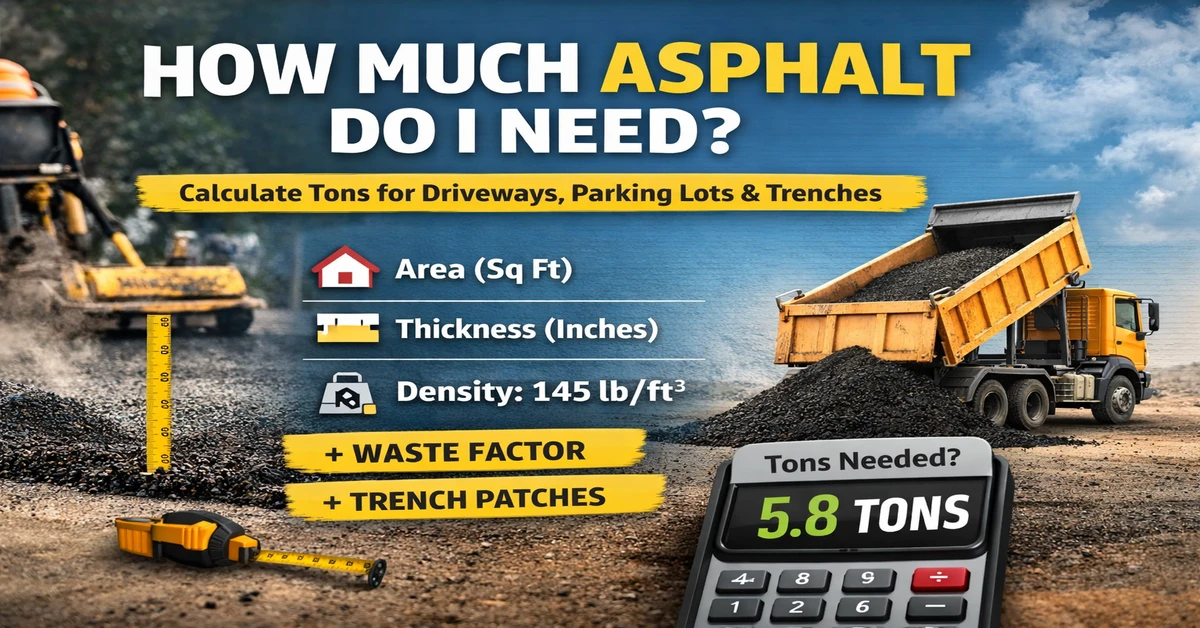
How Much Asphalt Do I Need? Calculate Tons for Driveways, Parking Lots & Trench Patches
Ordering asphalt sounds simple—until you try to convert square feet and inches into tons. Many homeowners and contractors either overbuy (wasting money) or underbuy (delays, cold joints, extra delivery fees). This guide solves that.
You’ll learn how to calculate how much asphalt you need, step-by-step, using the same logic most online asphalt calculator tools use—plus a dedicated section for utility cuts and trench patches, where people commonly mis-measure and come up short.
Try the Online Asphalt Calculator (sq ft → tons)
Quick Answer: The 3 Numbers You Need
To estimate how much asphalt do I need, you only need:
- Area in square feet (sq ft)
- Thickness in inches (converted to feet)
- Density of the asphalt mix (typical in-place range 142–148 lb/ft³)
Most calculators use 145 lb/ft³ as a solid default for hot mix asphalt (HMA) / asphalt mix (often called blacktop in the U.S.).
Rule of thumb:
Bigger area + thicker layer + higher density = more tons.
How to Calculate How Much Asphalt You Need (Step-by-Step)
If you’ve ever searched how to calculate amount of asphalt needed, this is the clean, reliable method.
Step 1: Measure the area (sq ft)
Measure the surface you’ll pave—driveway, parking lot, patch repair, lane/road, or a small pad.
- Rectangle: Length x Width
- Odd shapes: split into rectangles, calculate each, then add them.
Example (driveway):
40 ft × 12 ft = 480 sq ft
For driveways, use our Driveway Asphalt Calculator
Step 2: Convert thickness (inches → feet)
Asphalt thickness usually gets specified in inches—1.5″, 2″, 3″, or 4″.
Convert inches to feet:
- Thickness (ft) = Thickness (in) ÷ 12
Example: 2″ ÷ 12 = 0.167 ft
Step 3: Convert area to volume (cubic feet)
- Volume (ft³) = Area (sq ft) × Thickness (ft)
Example:
480 sq ft × 0.167 ft = 80.16 ft³
Step 4: Convert volume to weight (tons)
Use density in lbs per cubic foot (pcf).
- Weight (lb) = Volume (ft³) × Density (lb/ft³)
- Tons = Weight (lb) ÷ 2000
Example (using 145 lb/ft³):
80.16 × 145 = 11,623 lb
11,623 ÷ 2000 = 5.81 tons
✅ So, for a 480 sq ft driveway at 2″ compacted thickness, you need about 5.8 tons (before waste factor).
Asphalt Tons Formula
Use this formula when you want the same result an asphalt estimator gives.
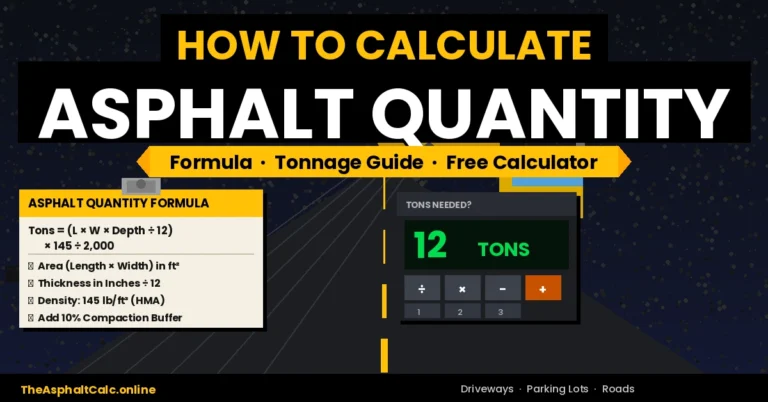
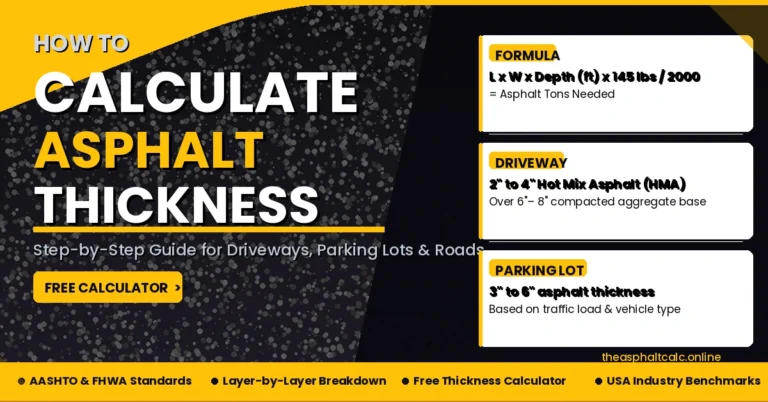
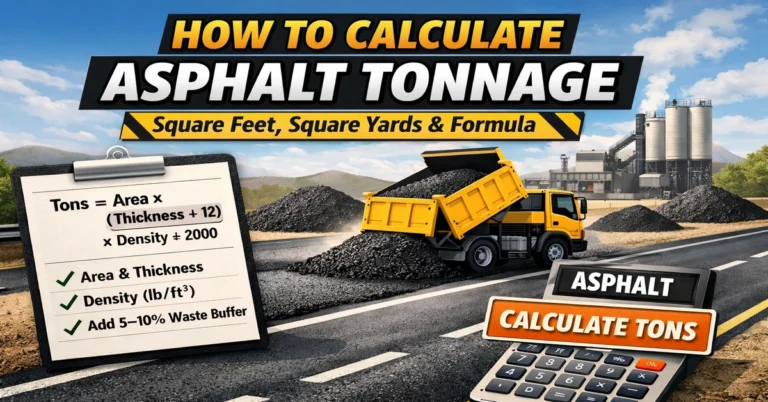
Asphalt Tons = (Area (sq ft) × (Thickness (in) ÷ 12) × Density (lb/ft³)) ÷ 2000
Default density for quick estimates: 145 lb/ft³
Typical range: 142–148 lb/ft³ depending on the mix, aggregate, and compaction.
Optional: Convert to Cubic Yards (yd³)
Some suppliers talk in cubic yards or you may see tons per cubic yard referenced.
- Cubic yards (yd³) = Cubic feet (ft³) ÷ 27
If you already have ft³ from Step 3, divide by 27 to get yd³.
Asphalt Thickness Guide (1.5″, 2″, 3″, 4″)
Choosing thickness is where many people get stuck. You don’t want to pay for extra material you don’t need—but you also don’t want cracking from going too thin.
Here’s a practical, U.S.-style guide:
| Compacted Thickness | Common Uses | Notes |
|---|---|---|
| 1.5″ | Light-duty resurfacing | Best over a solid existing base |
| 2″ | Typical residential driveway overlay | Common minimum for durability |
| 3″ | Heavier vehicles, frequent traffic | Better for pickups/utility use |
| 4″ | Commercial, parking areas, stronger structure | Often installed in multiple lifts |
Important: Asphalt is typically placed in lifts (layers). A thicker final depth may require two lifts for proper compaction and stability.
Compaction + In-Place Density: Why Your Tons Change
One reason people ask how many tons of asphalt do I need and get different answers is compaction.
Asphalt looks fluffy when it comes off the truck. After rolling, it becomes denser and thinner. That’s why many pros think in terms of:
- Loose thickness (before rolling)
- Compacted thickness (final in-place thickness)
Most quantity estimates assume compacted thickness. If you measure for 2″ but the crew places a loose mat that compacts down differently, your tonnage can shift.
Bottom line: Density and compaction matter most on:
- larger projects (parking lots, lanes/roads)
- surfaces with variable base
- trench patches with multiple lifts
Waste Factor: Add 5–10% (Don’t Skip This)
Even perfect math won’t save you if you ignore waste. Edges, grade changes, raking, and minor thickness variation consume extra material.
Use these simple guidelines:
- 5% waste: large, consistent paving areas (parking lot, long driveway)
- 7–10% waste: small areas, patch repairs, lots of edges, hand work
- 10%+: tricky trench restorations, uneven grades, multiple transitions
Recommended order quantity = Calculated tons × (1.05 to 1.10)
Example:
5.81 tons × 1.07 = 6.22 tons
You’d typically round up based on supplier minimums and delivery rules.
How Much Asphalt Do I Need After a Trench? (Utility Cut / Trench Patch)
Trench work is its own beast. People often underestimate because they measure the trench width but forget the saw cut area that actually gets patched.
This section covers:
- how much asphalt do i need after a trench
- asphalt quantity for trench patch / utility cut / trench backfill asphalt
What you should measure (don’t guess)
You usually patch wider than the trench itself. Measure:
- Saw-cut patch width (often wider than trench)
- Length of the patch
- Compacted lift thickness
- Number of lifts (common on thicker repairs)
Trench patch area (sq ft):
Patch length x patch width
Volume (ft³):
Area x (Thickness in ÷ 12)
Then convert volume to tons using density.
Trench Patch Example (Simple and Realistic)
Scenario: Utility cut patch
- Patch length: 30 ft
- Patch width (saw cut): 3 ft
- Final compacted thickness: 4″
- Density: 145 lb/ft³
- Waste: 10% (patching has edges + transitions)
Step A: Area
30 × 3 = 90 sq ft
Step B: Thickness in feet
4 ÷ 12 = 0.333 ft
Step C: Volume
90 × 0.333 = 29.97 ft³
Step D: Weight
29.97 × 145 = 4,345 lb
4,345 ÷ 2000 = 2.17 tons
Step E: Add waste
2.17 × 1.10 = 2.39 tons
✅ For this trench patch, you’ll likely need about 2.4 tons.
Trench lifts: why “one thick layer” causes trouble
A 4″ patch often performs better when installed as two 2″ lifts, compacted properly. That helps density, reduces cracking, and matches surrounding pavement elevation more accurately.
Online Asphalt Calculator vs Manual Formula (Which Should You Use?)
A good online asphalt calculator saves time, especially for standard projects like:
- basic driveway rectangles
- parking lot sections
- simple overlays
Manual calculation works better when you have:
- odd shapes
- multiple thickness zones
- trench patch geometry (saw cut vs trench width)
- multiple lifts and higher waste
Get a faster estimate with the Parking Lot Calculator
If you use a calculator, make sure it lets you adjust:
- thickness
- density (pcf)
- waste factor
Is There an App to Calculate Asphalt?
Yes—if you’re asking is there a app to calculate asphalt, you’ll find plenty of mobile options. A solid asphalt calculator app should do more than spit out a number. Look for these features:
What a good asphalt calculator app should include
- Input in sq ft, ft, and inches
- Thickness presets (1.5″, 2″, 3″, 4″)
- Density setting (so you can set 145 lb/ft³ or adjust)
- Waste factor toggle (5–10%)
- Unit conversions (ft³, yd³, tons)
Tip: Use the app for a quick estimate, then confirm final tonnage with your supplier or paving contractor—especially for trench restoration and larger pours.
Common Mistakes That Make Your Estimate Wrong
These mistakes show up constantly in driveway, patch repair, and utility cut projects:
- Forgetting inches ÷ 12 (biggest error by far)
- Measuring trench width instead of saw-cut patch width
- Ignoring waste (edges eat material)
- Mixing units (sq yd vs sq ft, yd³ vs ft³)
- Assuming one lift compacts perfectly on thicker patches
- Using a random density without checking typical range (142–148 lb/ft³)
FAQs
How to calculate how much asphalt I need / you need / is needed?
Measure area in sq ft, choose compacted thickness in inches, convert thickness to feet, then use:
Tons = (Area × (Thickness ÷ 12) × Density) ÷ 2000, then add 5–10% waste.
How many tons of asphalt do I need for a driveway?
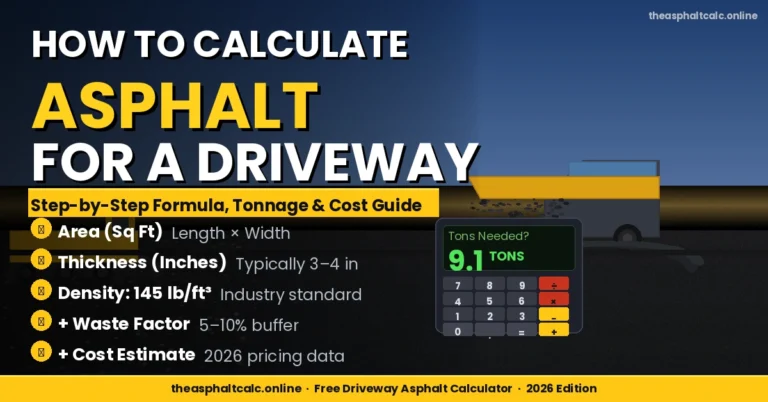
Most driveways land in the 3–10 ton range depending on size and thickness. Calculate using your exact sq ft and desired thickness (often 2–3 inches compacted).
What density should I use for hot mix asphalt (HMA)?
A practical default is 145 lb/ft³, while typical in-place density ranges 142–148 lb/ft³ depending on mix and compaction.
How much extra asphalt should I order?
Plan 5–10% extra. Use the higher end for patch repairs and trench work.
How much asphalt do I need after a trench?
Use the saw-cut patch width, not the trench width, and add ~10% waste. Trench patches have more edges and transitions, so under-ordering happens easily.
Final Checklist (Before You Order)
- ✅ Confirm total sq ft
- ✅ Confirm compacted thickness
- ✅ Use 145 lb/ft³ unless you have a better mix-specific number
- ✅ Add 5–10% waste
- ✅ For trench patches, measure saw cut dimensions and plan for lifts