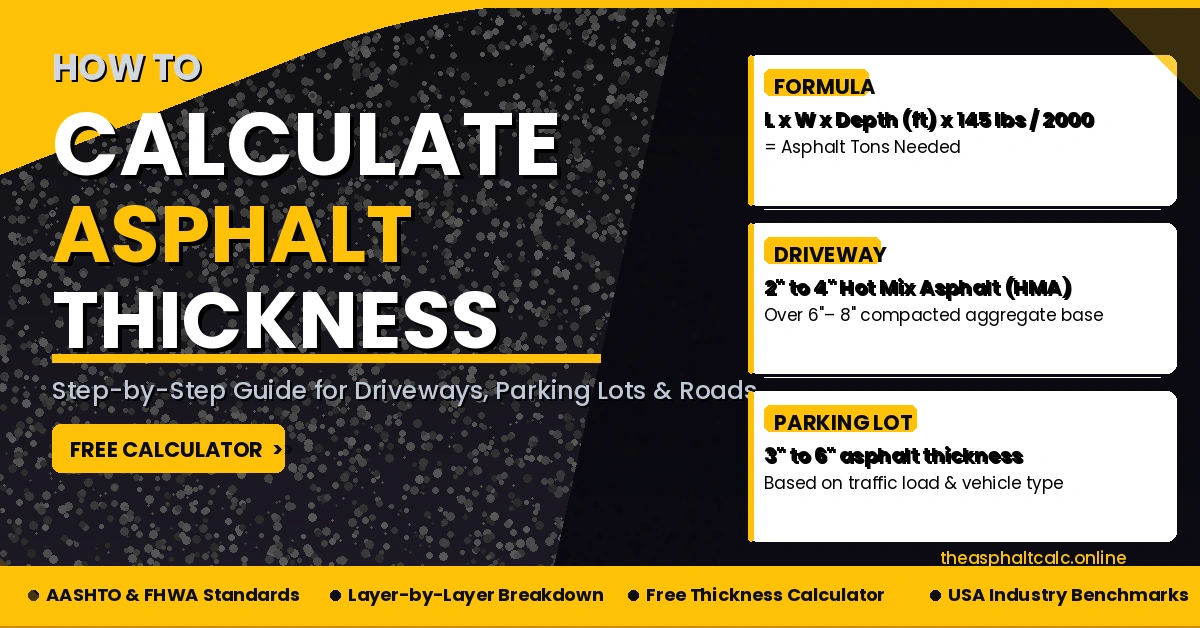
How to Calculate Asphalt Thickness for Driveways, Parking Lots & Roads
Getting asphalt thickness wrong is one of the most expensive mistakes you can make on a paving project. Too thin, and you’re looking at cracks, potholes, and early failure within 5 to 10 years. Too thick, and you’ve wasted thousands of dollars on unnecessary material. Whether you’re planning a residential driveway, a commercial parking lot, or a road, knowing how to calculate asphalt thickness correctly is the difference between a 25-year surface and a 5-year headache.
This guide walks you through the complete asphalt thickness calculation process — from the formula and pavement layer breakdown to use-case thickness standards and a free tool to do the math instantly. Use our Asphalt Thickness Calculator to get your numbers in seconds.
What Determines Asphalt Pavement Thickness?
Before you run any numbers, you need to understand the four core factors that drive pavement thickness calculation. Skip these, and even a perfect formula gives you the wrong answer.
1. Traffic Load This is the biggest factor. A residential driveway handling two sedans has completely different thickness requirements than a commercial lot running delivery trucks all day. Engineers express cumulative traffic impact using a unit called ESALs (Equivalent Single Axle Loads) — a standard developed by AASHTO (American Association of State Highway and Transportation Officials) to normalize the damage caused by different vehicle types. A fully loaded semi-truck weighing 80,000 lbs creates roughly 26 times more pavement stress than a standard 3,000 lb passenger car.
2. Subgrade Soil Conditions The subgrade is the native soil beneath your entire pavement structure. Weak, clay-heavy, or poorly draining subgrade requires thicker asphalt or a stronger aggregate base to compensate. Sandy or gravelly soils with good drainage can often support thinner applications. Engineers use the California Bearing Ratio (CBR) to measure subgrade strength — a low CBR means you need more thickness above it.
3. Climate and Freeze-Thaw Cycles In cold-weather states like Minnesota, Michigan, or New York, freeze-thaw cycles push water into pavement cracks, expand them, and accelerate deterioration. The Federal Highway Administration (FHWA) consistently identifies freeze-thaw damage as a leading cause of premature pavement failure. In these regions, adding at least a half-inch to your standard thickness recommendation is a smart protective move.
4. Pavement Layer Structure Asphalt pavement is not a single slab — it is a layered system. Each layer has a role:
| Layer | Material | Typical Thickness |
|---|---|---|
| Surface Course | Hot Mix Asphalt (HMA) | 1.5″ – 3″ |
| Binder Course | Coarser HMA mix | 2″ – 3″ |
| Base Course | Dense-graded HMA or aggregate | 4″ – 8″ |
| Subbase | Compacted gravel/crushed stone | 4″ – 12″ |
| Subgrade | Native soil (compacted) | Varies |
The interaction between these layers determines overall pavement load-bearing capacity. A thin asphalt surface on a weak base course will fail regardless of how perfect your top layer is.
The Asphalt Thickness Formula (Step-by-Step)
For everyday residential and commercial projects, the core asphalt thickness formula is straightforward. Here is how to calculate it manually.
Step 1: Determine the Required Structural Number (SN)
The AASHTO 1993 design method — the industry standard used by engineers and state DOTs across the US — uses a Structural Number (SN) to represent the total strength your pavement must deliver. The SN accounts for traffic loads, subgrade strength, reliability level, and serviceability.
For practical purposes, most non-engineering users work from established thickness tables based on use case (see the chart below). Engineers solving for SN use the full AASHTO equation with ESALs, resilient modulus (M_R), and reliability inputs.
Step 2: Select Your Layer Coefficients
Each pavement material has a layer coefficient (a) that represents its structural contribution per inch of thickness. Per AASHTO standards:
- Dense-graded Hot Mix Asphalt (surface): a = 0.44
- Asphalt base course: a = 0.34
- Granular aggregate base: a = 0.14
Step 3: Calculate Each Layer’s Thickness
Once you know the required SN, divide it by the layer coefficient to find the thickness needed from that layer:
D = SN ÷ a
For example, if your project requires SN = 3.0 and you are using standard Hot Mix Asphalt with a = 0.44:
D = 3.0 ÷ 0.44 = 6.8 inches of HMA surface course
In practice, engineers split this across multiple pavement layers rather than putting it all in the surface course.
Step 4: Convert Thickness to Volume and Tonnage
Once you have your asphalt layer thickness, use this formula to calculate how much material you need:
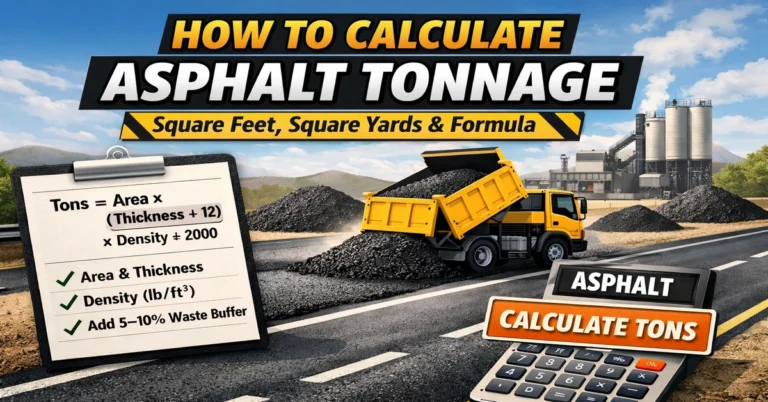
Volume (cubic feet) = Length (ft) × Width (ft) × Thickness (ft) (Convert inches to feet: divide by 12)
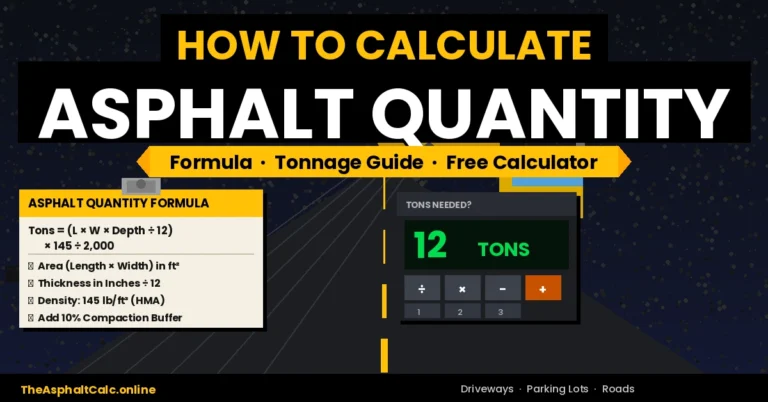
Weight (lbs) = Volume × 145 lbs/ft³ (Standard density of Hot Mix Asphalt per ASTM International standards)
Tons = Weight ÷ 2,000
Example Calculation: You are paving a 50 ft × 100 ft parking lot at 3 inches (0.25 ft) depth:
- Volume = 50 × 100 × 0.25 = 1,250 cubic feet
- Weight = 1,250 × 145 = 181,250 lbs
- Tons = 181,250 ÷ 2,000 = ~90.6 tons
Always add 5–10% for compaction loss and waste. Final order: approximately 95–100 tons.
Skip the math entirely — use the free Asphalt Thickness Calculator at TheAsphaltCalc.online to get instant results for your exact project dimensions.
Asphalt Thickness Standards by Project Type
This is the section most homeowners and property managers actually need. Here is the asphalt thickness chart by use case, based on AASHTO guidelines and industry-standard construction practice used across the US.
Residential Driveways
| Driveway Type | Asphalt Thickness | Aggregate Base |
|---|---|---|
| Light duty (passenger cars only) | 2″ – 2.5″ | 4″ – 6″ compacted base |
| Standard residential | 3″ | 6″ – 8″ compacted base |
| Heavy duty (trucks, RVs, trailers) | 3.5″ – 4″ | 8″ compacted base |
Asphalt thickness for a driveway should never go below 2 inches. Anything thinner shows failure rates 2 to 3 times higher than properly specified installations, particularly in climates with freeze-thaw cycles.
Commercial Parking Lots
| Parking Lot Type | Asphalt Thickness | Base Layer |
|---|---|---|
| Light duty (passenger cars) | 3″ | 6″ – 8″ aggregate base |
| Standard commercial | 3″ – 4″ | 8″ aggregate base |
| High traffic / drive lanes | 4″ – 5″ | 8″ – 10″ |
| Loading docks / dumpster pads | 5″ – 6″ | 10″ – 12″ |
| Heavy trucks and delivery vehicles | 6″ – 8″ | 12″+ |
Asphalt thickness for a parking lot depends heavily on whether the lot is full-depth asphalt or built over an aggregate base. A full-depth light-duty lot needs at least 4 inches of Hot Mix Asphalt (HMA) on the compacted subgrade. A heavy-duty full-depth lot may require 7.5 inches.
Roads and Highways
| Road Type | Total Asphalt Thickness |
|---|---|
| Residential street | 4″ – 5″ |
| Collector road (medium traffic) | 5″ – 6″ |
| Arterial road / high traffic | 6″ – 8″ |
| Highway / Interstate | 8″ – 12″+ |
Asphalt pavement thickness for roads is determined using the full AASHTO design methodology with ESALs projected over a 20-year design life. Local DOTs and the FHWA set minimum standards that contractors must meet for public roadway construction.
Why Is Volumetric Calculation Important in Asphalt?
A question that comes up repeatedly — especially among contractors estimating jobs — is why we convert thickness to volume before ordering material.
The answer: asphalt is sold by the ton, not by the inch. You cannot walk into a plant and order “3 inches of asphalt.” You order tons. To get from your design thickness to tons, you must go through volume first, then apply asphalt density (145 lbs/ft³ for standard Hot Mix Asphalt, per industry and ASTM standards) to convert volume into weight.
Getting this wrong — even by a small margin — means you either run short mid-job or you over-order and waste money. On a 10,000 sq ft parking lot at 3 inches, a 10% error in your volumetric calculation means you are off by roughly 9 to 10 tons, which can cost you $500–$800 at current asphalt prices.
Compaction factor also plays into this. Asphalt is laid loose and then compacted down. The compaction factor for Hot Mix Asphalt typically runs between 1.15 and 1.25, meaning your loose material volume is 15–25% greater than the final compacted depth. Always account for this when ordering.
Also Read: How Much Asphalt Do I Need
The Pavement Layer System Explained
One thing that frustrates homeowners and small contractors is that no two sources seem to agree on exact thickness numbers. That is because asphalt pavement design is not a single number — it is a system.
Here is what each layer does and why it matters for your thickness calculation:
Surface Course This is what you see and drive on. Made of fine-graded Hot Mix Asphalt (HMA), the surface course handles direct traffic wear, weather exposure, and drainage. It typically contributes 1.5 to 2 inches of the total thickness.
Binder Course Beneath the surface, the binder course is a thicker, coarser HMA mix. It distributes loads across the surface and transitions stress down to the base. On heavy-duty lots, the binder course alone may be 2 to 3 inches.
Base Course The base course is either a lower-quality asphalt mix or a compacted aggregate material. Its job is load distribution and providing a stable platform. Poor base course construction is cited by the FHWA as the primary cause of premature pavement failure — more often than the asphalt surface itself.
Subgrade The subgrade is the compacted native soil. All pavement design ultimately comes back to subgrade strength. If the subgrade is soft, weak, or improperly compacted, no amount of asphalt thickness above it will prevent eventual failure.
Common Asphalt Thickness Mistakes (And How to Avoid Them)
These are the real-world problems that come up again and again on Reddit threads, contractor forums, and professional paving consultations:
- Skipping the base layer entirely. Some budget contractors place asphalt directly on unprepared subgrade. This always fails prematurely.
- Underestimating traffic load. A residential driveway that later gets used for RV parking or a boat trailer needs to be designed for heavier loads from day one.
- Ignoring climate. In freeze-thaw states, thin asphalt without adequate drainage invites moisture intrusion, ice expansion, and cracking.
- Not accounting for compaction. Ordering based on compacted thickness without the compaction factor leads to material shortages on-site.
- Treating the whole lot as one thickness. Drive lanes, parking stalls, loading docks, and dumpster areas all carry different loads and should have different thickness specifications within the same project.
Use the Free Asphalt Thickness Calculator
Manually calculating asphalt thickness, volume, and tonnage is time-consuming and error-prone. Our free Asphalt Thickness Calculator at TheAsphaltCalc.online handles the entire calculation for you.
Enter your:
- Project length and width
- Planned asphalt depth (or select by project type)
- Material density
Get instant results for volume in cubic yards, total weight in tons, and material estimates — no formulas, no unit conversions, no math errors.
Calculate Your Asphalt Thickness Now →
Asphalt Thickness Chart: Quick Reference
| Application | Min. Asphalt Thickness | Recommended Base |
|---|---|---|
| Residential driveway (light) | 2″ | 4″–6″ |
| Residential driveway (standard) | 3″ | 6″–8″ |
| Residential driveway (heavy) | 3.5″–4″ | 8″ |
| Parking lot (light duty) | 3″ | 6″–8″ |
| Parking lot (commercial standard) | 3″–4″ | 8″ |
| Parking lot (heavy trucks) | 5″–6″ | 10″–12″ |
| Local road | 4″–5″ | 6″–8″ |
| Highway | 8″–12″ | 12″+ |
| Loading dock / dumpster pad | 5″–6″ | 10″–12″ |
Standards based on AASHTO guidelines and FHWA pavement design recommendations.
Frequently Asked Questions
How thick should asphalt be for a residential driveway?
For a standard residential driveway handling passenger cars, 3 inches of compacted Hot Mix Asphalt over a 6 to 8-inch compacted aggregate base is the most widely recommended specification. If you park heavier vehicles like trucks, RVs, or trailers, step up to 3.5 to 4 inches. Never go below 2 inches — driveways built under that threshold have documented failure rates 2 to 3 times higher than properly specced installations.
What is the asphalt thickness formula for calculating tonnage?
Multiply your Length × Width × Thickness (all in feet) to get cubic feet. Then multiply by 145 lbs/ft³ (the standard density of Hot Mix Asphalt) to get total weight in pounds. Divide by 2,000 to convert to tons. Add 5 to 10% for compaction and waste. Or use the Asphalt Thickness Calculator to skip all manual steps.
How thick does asphalt need to be for a commercial parking lot?
Light-duty commercial parking lots for standard passenger vehicles typically need 3 to 4 inches of asphalt over an 8-inch compacted aggregate base. Areas handling heavy trucks, delivery vehicles, or loading zones should have 5 to 6 inches, and full-depth heavy-duty lots may require up to 7.5 inches of Hot Mix Asphalt on the subgrade.
What is the AASHTO method for asphalt pavement thickness design?
The AASHTO 1993 flexible pavement design method uses a Structural Number (SN) equation that factors in cumulative traffic load (expressed as ESALs), subgrade resilient modulus (M_R), design reliability, and serviceability loss. The SN is then converted to actual layer thicknesses using material-specific layer coefficients. Dense-graded HMA typically uses a layer coefficient of 0.44.
What happens if asphalt is laid too thin?
Asphalt that is too thin distributes load unevenly, leading to fatigue cracking, rutting, and pothole formation. In freeze-thaw climates, thin pavement allows water to penetrate deeper layers, accelerating structural failure. Industry data shows that underspecified asphalt reduces pavement lifespan from 20+ years down to 5 to 10 years and increases long-term maintenance costs by 40 to 60%.
Does subgrade condition affect asphalt thickness?
Yes — significantly. Clay-heavy or soft subgrades require greater total pavement thickness because the weak soil cannot adequately distribute loads. Engineers use the CBR (California Bearing Ratio) value to measure subgrade strength. A subgrade with a CBR of 3 requires substantially more asphalt above it than a subgrade with a CBR of 10. Proper subgrade compaction before any paving begins is non-negotiable for long-term pavement durability.
Conclusion
Calculating asphalt thickness correctly protects your investment, prevents premature failure, and saves real money on both installation and long-term maintenance.